Tehyah’s Story
“On 21st July 2010 a little angel was born, my granddaughter, Tehyah. Seemingly healthy, our little princess Tehyah went through life being a gorgeous, cheeky little madam!
On the 11th March 2014 Tehyah went skipping off to nursery laughing. However, at dinner time we had a call to say she was unwell and we should come and collect her. The next morning, my daughter Sam, Tehyah’s Mum, phoned me as she thought Tehyah had suffered a stroke. I just didn’t think this was possible as Tehyah was only 3. I rushed round to my daughter’s house and Sam was right, Tehyah certainly looked like she had suffered a stroke. She was rushed to A&E at Oldham Royal Hospital. They checked her and said it looked like Bell’s Palsy and sent her home with a course of steroids. After four days Tehyah became so sick that Sam took her to A&E again. She was monitored and she spent a few weeks in Oldham Royal. Scans showed nothing and the consultants did not think there was anything seriously wrong. Soon after that they were ready to discharge Tehyah but decided to send her to Manchester Children’s Hospital first for a full MRI scan, just to make sure.
Tehyah was transferred in an ambulance and a full MRI scan was carried out revealing that Tehyah had suffered multiple strokes which had damaged her brain, that the blood vessels to her brain were not all connected, that her vessels in her neck were narrowing and that she had an enlarged heart and kidney problems. Our family were told that our little princess needed an operation or she would die – even with the operation she may still not make it. The hospital were baffled by what was happening 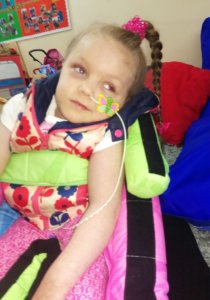
and so needed to contact surgeons all over the world to give Tehyah a chance. Amazingly at this point Tehyah was still running around, eating, drinking, speaking and playing. Tehyah was taken to theatre on the 11th April 2014. She went through ten and half hours of life saving brain surgery. Tehyah woke from this surgery asking for water and she was then transferred to a different ward where she was able to eat, laugh and talk. Eight days later, her condition began to deteriorate and another scan showed brain swelling and fluid on the brain. That night, she was rushed to theatre again to have a drain put in her brain. Three hours later, she was back into theatre as the fluid was building up so much. They removed a part of her skull to allow for the swelling. She was then taken into intensive care, put into an induced coma and on a ventilator for weeks. During this time, expecting the worst, we baptised her. Tehyah fought very hard and eventually she was slowly brought out of the coma and was breathing on her own. At this point we discovered that despite it being on her records that she was seriously allergic to antibiotics, whilst in theatre Tehyah was given a dose of antibiotics that sent her into anaphylactic shock but the surgeons managed to save her. Yet again, after the surgery when she was in intensive care, Tehyah was incorrectly given antibiotics and had to be resusitated.
This resulted in serious brain damage and from this day she never talked, walked or ate again. We were told that she would have no quality of life. On 26th June 2014, Tehyah was given two weeks to live and we took her home. She is still here nearly four years later, thank God! Tehyah now communicates by smiling and laughing and makes sounds when you talk to her and to let you know she’s there. She also attends a very complex needs school called Kingfisher which is amazing and she loves every minute in the school. She has 24 hour round the clock care and is loved by everyone who meets her.
Genetic tests were carried our about a year after Tehyah was discharged from hospital to try and find out what caused all of this to happen. They have now diagnosed her with one of the rarest conditions in the world GACI, Generalised Arterial Calcification in Infancy, which is a life limiting, cruel, horrible condition. It results in the abnormal accumulation of the mineral calcium (calcification) in the walls of the blood vessels that carry blood from the heart. We had Tehyahs older sister Aaliyah and younger brother Dantay tested who at the time were aged 6 years and 4 years. We were absolutely heartbroken and shocked to find out that Dantay has exactly the same condition as Tehyah and that Aaliyah is a carrier of the condition. Dantay is on a medication now to try and prevent the calcification spreading and has regular scans and tests to monitor the progression of the condition.
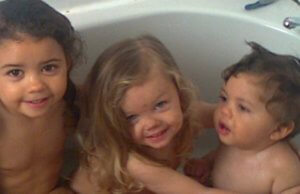
We are devastated and heartbroken at what has happened to our family and I cannot believe what my daughter, her partner and their beautiful children have gone through and what they will have to face in the years to come. Life has never been the same since that day in March 2014 and will never be the same again, to have known Tehyah from the minute she was born until everything about her was taken away is just unbearable. Family life is difficult as it’s not easy to get out and about now due to all the equipment needed to even go to the cinema, shops, anywhere is a struggle. Tehyah cannot be left unattended not even for a minute, she is doubly incontinent, tube fed, ventilated, on a huge amount of medication and cannot move on her own.
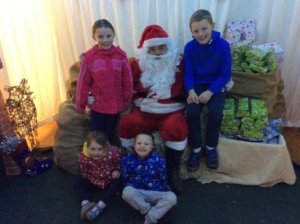
However, we have been lucky to have amazing people around us who have helped us fundraise for the vital equipment that she needs and we have had some incredible support from charities, there are so many people who help and care. We are truly grateful to The Sandcastle Trust for trying to help make life a little more bearable – they provided us with a lovely day out to visit Santa at Chester Zoo this year and we are all looking forward to the very much needed family short break away they have arranged at Brick Farm Cottages next year.”
Debra Walker (Tehyah’s Grandma)
Isla’s Story
“Growing up I never wanted a career all I wanted was to be a mummy.
I met my partner Peter in 2010, I was 25 Peter 28 and we decided to start a family. Unfortunately I suffered two missed miscarriages before becoming pregnant again. I had another scare at 8 weeks but an emergency scan revealed a lovely heartbeat! I absolutely loved being pregnant.
We found out we were having a girl and we knew from then she would be called Isla-Rose.
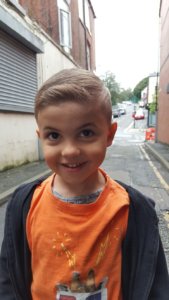
Isla-Rose was born 14th April 2014. She was perfect.
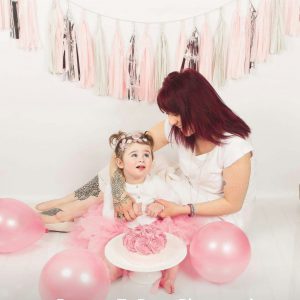
The first few weeks were spent holding her and watching her for hours. I didn’t get bored of it. Daddy would go to work and come home to find us still cuddled on the sofa. She was growing into a little character and made me laugh every day.
24th August 2014 was a normal summer’s day. Isla was 4 ½ months old. I was getting Isla ready to go out but when I picked her up I noticed she was twitching down her left side, it looked like a trapped nerve so I tried moving her arm. It wouldn’t move. Her face then started dropping. ‘She’s having a stroke’ I said to my friend. I rang 999 and explained what was happening. I started sobbing, my friend said ‘don’t cry Rachael you must be strong for Isla she needs her Mummy to be strong’.
We were blue lighted to hospital and spent five hours in resus while the doctors tried to work out what was happening.
Daddy was on his way, when he arrived and saw his 4 month old baby hooked up to machines with IV lines everywhere he broke.
They managed to stop the twitching and we spent a few days in hospital. Isla recovered and was back to her cheeky self. We were told it was a febrile convulsion. We went home relieved it was all over.
Two weeks later we were out for dinner with family. Isla went quiet and then the twitch appeared. It then took her whole left side. She struggled to breathe. We rang 999 again and spent another night battling in resus to get her back. Her heart rate would hit 200, her oxygen dropped to 80s. They resuscitated her and in the end put her into a coma. We knew then something wasn’t right and more needed to be done.
Isla spent 48 hours on life support but recovered within a day! She shocked us all but still we had no answers as to why. All her tests came back normal.
When we got home we kept an eye on her but it happened again six weeks later. This was to be our story – every six weeks or less Isla would go into a status seizure. Her shortest seizure being 40 minutes her longest, hours!
In total Isla has been on life support four times and blue lighted to hospital seventeen times. I’ve learnt how to resuscitate her and give her emergency medication. Isla was put on three epilepsy medications with no effect. We have to travel everywhere with oxygen.
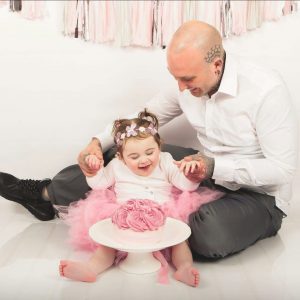 Then in January 2015 we were told that Isla has Dravet Syndrome. A rare genetic epilepsy that affects 1 in 40,000. We looked up the condition on the internet where it was described as ‘a catastrophic epilepsy’. We read that children lose their abilities as they grow older and many don’t survive the long, dangerous seizures the syndrome causes.
We were devastated, it wasn’t meant to be like this. We had battled hard to get her and now she was given this life. I felt she deserved more from this world.
On the surface Isla looked like any normal child but when Dravet hit, it hit hard. I learnt quickly to be organised and to know all the answers that the doctors needed from me in times of emergencies.
We had nearly made it through the first year of Dravet, which is apparently the most dangerous. But then, in July 2015, I was at a friend’s house and Isla was playing with her little friend, laughing. I noticed a change in Islas tone. I shouted at my friend to grab the oxygen.
The seizure came with such force I struggled to keep her alive. The ambulance was on its way but I knew I needed to save her myself. I kept Isla alive for 40 minutes while I waited for the ambulance. The medicines were given and now my job was to keep her breathing. I lost count of how many times I got Isla breathing again that evening. We lay on my friend’s living room floor while doing lifesaving treatment.
When we arrived in resus they took one look at her and put her straight into coma. Strangely I thought ‘phew she’s safe now’. I just need her to wake tomorrow and start the recovery as we had done so many times before. But she didn’t wake, she wouldn’t come off the breathing machines. They did brain scans to see if any lack of oxygen had given her brain damage.
Isla spent two weeks on life support but when she came around she wasn’t the little girl I knew. She behaved like she was blind and had all over body spasms, they did another brain scan. This time the brain had time to react, they told us she had brain damage. Not from the lack of oxygen but from trauma caused by the intense seizures. They had no other answers for us. They didn’t know what her quality of life would be or if she would survive.
Six weeks in total we spent in The Evelina Hospital.
When we got home our lives had changed. Isla couldn’t see, talk, eat or support herself in any way. She would have muscle spasms that would send her screaming in pain. I was heartbroken and lost. I didn’t know what to do to make things better for her and she couldn’t tell me. We cried for days, weeks and to be honest I still do now, at random times and never in front of Isla. Another mummy said to me ‘you must grieve for the child you lost, and then celebrate the child you have now’.
I must say that took me a very long time. I missed Isla terribly I couldn’t look at photos before the brain damage and if I did I would say ‘mummy misses you so much’.
My heart was full of guilt, guilt for missing my funny energetic Isla. Many children don’t survive what Isla went through and the doctors were surprised she did. I should be grateful for that. But I just couldn’t help it. I missed her terribly. The first year of brain damage has been hard. I’ve fallen in love with my new Isla but still miss the old Isla very much.
Me and my partner struggled at different times. We held each other up when one would break and I’m thankful we are making it through this together.
We have had another little girl who is now 3 months old, Betsy. We were tested before having her and given the all clear. Isla’s Dravet was a spelling mistake in her genes. Such a tiny thing caused devastation in our world. I wish Isla had a better life and didn’t have to fight to survive. However this is what is happening so we have promised to make the most of every day. We lose children with Dravet nearly every month.
Another Dravet mum who recently lost her little boy to SUDEP (sudden unexpected death in epilepsy) said to me ‘it’s the quality of life that’s important not the quantity’.
That’s what we go forward with. Each day is precious with our Isla and I plan to waste no days.
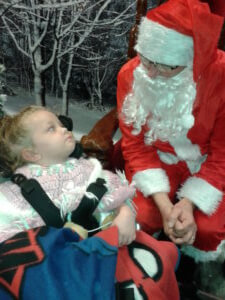
Thanks to The Sandcastle Trust Isla met Santa this year surrounded by all her family.”

Oscar’s Story
Little Oscar points at a picture of a canal boat at his aunt’s house and says: “Me! Me!”
The young boy with profound disabilities had the holiday of lifetime on a canal trip thanks to The Sandcastle Trust and despite his limited vocabulary, he talks about it whenever he can.
Oscar’s dad Justin, 44, from Ipswich, says: “The canal trip was an absolutely wonderful few days, such a memorable holiday.
“Oscar was able to feed the ducks as we went along. He could point at the scenery.
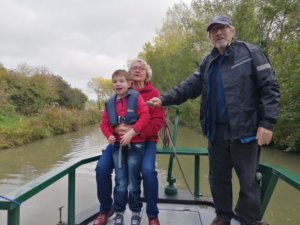 He helped drive the boat and moor up, all of which was great for his self esteem and language development and great for us to have something we could all do as a family.”
Oscar was born with 49 4-XXXXY syndrome and was diagnosed shortly after his birth. Symptoms of this extremely rare genetic condition include global development delay, Oscar finds eating hard and has low muscle tone. Aged seven he also has hyper mobility which means he has a permanent elbow dislocation. He also suffers from poor kidney function.
But Justin says Oscar is a real character in spite of his many disabilities. “He is cheeky and very engaging.
“Despite his inability to communicate he will draw a crowd. He uses a lot of facial expression and body language to entertain people. He will want to share everything. He will drag strangers off the floor to dance if we’re at a festival, usually older ladies.
“He absolutely loves music it has always been a soother for him. Music is the constant that stops any emotional outbursts.”
Justin, a youth justice practitioner and Oscar’s mum Kirsty at times find it hard to arrange holidays that cater for the whole family.
Justin says: “None of us want to sit somewhere on holiday, we like to be moving. So the canal trip was ideal. We thought Oscar would like the scenery going past and we could stay warm.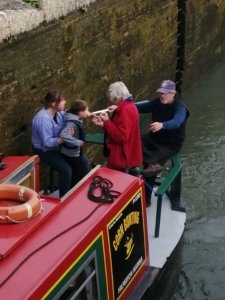
“We applied for a short break award from The Sandcastle Trust and got it.
Until now the family have been fairly limited in where they take Oscar.
Justin says: “When he was smaller, he had a couple of bouts of pneumonia. We still worry about infection but we have antibiotics stored at home.
“Oscar was peg fed for six years because he wouldn’t eat. He never felt hungry. But he needs lots of calories because his low muscle tone means it takes a lot of energy to move.
“This trip was really important to us as a family. One of the best things was it increased Oscar’s vocabulary. On his talk pad communication device he now has the words “canal” and “lock” and “jump” – as in on and off.
“You can see how much he treasures the memories.”

Isabelle’s Story
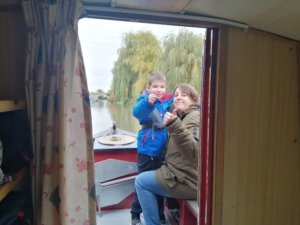
“My pregnancy was like every other “normal” pregnancy, filled with excitement and anticipation for the new addition to our family.
I give birth at home and get handed my little girl (she is not crying). I look at her and hand her straight back to the midwife “there is something wrong” I say. They rub her and she begins to cry. “She is fine” they tell me, handing her back. I look into her eyes and just cannot connect like I had with my first child. I feel terribly guilty. What is wrong with me? Me and my husband both cuddle her in turns and settle on the name Isabelle. Family come to see her, cooing and complementing us on our beautiful girl.
 Something is just not right. I try to breastfeed her. She has trouble latching on – on, off, on, off. We switch to bottles. Maybe this will help? But she takes an ounce and stops, cries, we try again. Maybe wind? Forever winding her, feeding her, trying to settle her. She won’t take her bottle unless we are in a quiet place as she is easily upset by noises. Several visits to the doctors and they diagnosed her with colic. They tell me she is just an unsettled child and there is nothing wrong.
As she grows, milestones are not met. Her eyes will not follow us, she won’t engage and has no interest in toys or books or even us! At 6 months we are weaning and she can not tolerate foods; unless they are super smooth we have no chance. More visits to doctors and midwife clinics and we get the same response “she is just a fussy eater”, “have you tried this…”
Just shy of 1 year old and we are still trying to get her to swallow food with lumps with very slow progression. She will not sleep properly and is often up in the night. Sometimes Isabelle is crying, other times just wants to play! I cannot hack this. She needs me 24/7. I have another child I can’t look after. She takes everything from me. I often get upset at night and cry until I fall asleep. I can’t make sense of it. The doctors say she is fine, that she must be a difficult child and she will grow out of it.
Her 1st birthday! A happy occasion, for most. We however spend the whole night awake. Isabelle just won’t stop crying. Nothing will help. I’m going crazy. I take her to her 1 year check-ups and explain again that she is not meeting her milestones. I must look a state. I am exhausted and at my wits end.
I am back at the doctors that afternoon, my mum with me to back me up as I am barely functioning myself anymore. “She is constipated. This prescription should help. I will also refer her to the Paediatrician.” At last! Someone is listening to me. I’m also being put on anti-depressants. This should help me cope better.
2 months on I get signed off sick from work, get counselling and have my anti-depressants upped. Shortly after I quit my job. My daughter needs me. This will be financially tough for us. I am losing a my salary, so I can be with Isabelle, and help get me back on track. If I don’t sort myself out, how can I look after my kids? It will be so tough. My husband starts to work 6 days a week and longer hours to help with money.
The paediatricians won’t listen to me, nothing is wrong. Again. 6 months on and I finally see a different paediatrician. “Interesting, she is not meeting her milestones. Not sleeping well, and her facial characteristics…. Sticky out ears, large forehead, very long and skinny…” Wow, I’m glad I am getting somewhere, but really she needs to stop picking on all Isabelle’s flaws!
We go back again, and again for further check-ups. Tests, examinations, referrals to physiotherapy as she cannot yet crawl. Speech therapy as she is not yet communicating, MRI scan and finally – genetics tests.
 It is just before her 2nd birthday. We get a phone call from our paediatrician. “Could you come to see me.” Well this can’t be good. What have they found. Me and my husband drive up to the hospital to discuss the results “I am so sorry. As you probably have guessed, your daughter’s genetics have come back with a condition. 1P36 deletion syndrome.” She reads it from the leaflet she has on her desk. “I have never come across this before, I have researched it and have this leaflet for you. She will need life long care.” We sit in shock. I dare not look at my husband but I can tell he is trying not to cry. I take his hand and we listen as the list continues. The paediatrician reads points out from the leaflet “developmental delay…hypertonia…feeding difficulties…seizures…disease of the heart/minor heart defects…hearing and vision loss, large soft spot, spine problems, thyroid problems, issues with kidneys, infections, digestive disorders…” I think I have gone numb. I cannot listen anymore. I’m nodding at the words but not really taking it in. Life long care! Life long. Forever. There is no cure, and it could get worse. We leave the hospital. I drive as my husband’s eyes are still red from crying. We start driving home. “Are you ok?” Am I ok? No not really. It is not fair. Why me? I start to cry, hard. My husband calls my parents on the way home to tell them, then we stop at his parents and he goes in to tell them. I stay in the car crying. I don’t want to tell people. I want to protect her. Protect us from the stream of questions even I can’t answer. I get home and get straight onto the computer. I look up a Facebook group and within hours I am added to their closed group – The 1P36 Families. I am welcomed with open arms, floods of wonderful people saying Hi.
We meet up with them in the August. A welcome group of wonderful, beautiful families. Varying in needs, but all so inspirational. For the first time in over 2 years I feel like I belong. These people get it. We are all open and honest with each other. A lifeline.
Today and Isabelle is doing well. She is now walking and although not talking, is learning Makaton. She does have seizures now and is on different medications for various issues related to her genetic condition. We also have to be careful of sensory overload but she is much happier. We understand her. She loves bubbles, and a good old selfie! I still have my moments of sadness, as me and my husband come to terms that the daughter we had dreamed of is now “different”, our lives changed. However we love her unconditionally. We are a strong little family. Times can still be hard with finances, but thanks to The Sandcastle Trust we have now got a Family Annual Merlin Pass. It has helped provide some short term escapes for us, and a way to enjoy life as a family again without the financial burden. Some beautiful pictures of our adventures out that we will treasure forever. I now regularly fundraise and have become more involved with The Sandcastle Trust. I have recently become a trustee. Our family is kept very busy with doctor and therapy appointments for Isabelle along with all those other day to day chores we must get done. Life is much better. We are happy.”
Evana’s Story
“My daughter Evana is 3 ½ and it’s her birthday soon as she likes to tell us, a lot!
When she was a baby Evana was late meeting all her developmental milestones. She didn’t roll (she still can’t roll now), didn’t smile until 12 weeks, didn’t sit until 11 months and didn’t crawl until 13 months. When Evana was 17 months old she still couldn’t weight bear. After months of having my concerns dismissed and being told by heath visitors that she would catch up with her peers in her own time, I took her to the GP who immediately referred her to a paediatrician.
Evana had a series of x-rays and blood tests, all of which came back normal, so she was then sent for genetic testing. This genetic test told us that Evana has a 15q11.2 microdeletion, a rare chromosome disorder. It was subsequently discovered through further testing that I also have the same microdeletion as Evana, which was completely unexpected as I have never experienced any symptoms as a result of it.
 Evana’s chromosome disorder causes her to have Global Developmental Delay – her speech and understanding are delayed, sensory issues, hypermobility and her paediatrician thinks she could possibly be autistic. Evana took her first steps around her second birthday but still uses a special needs buggy to get around as she is very prone to falls. She experiences a lot of pain, mostly in her knees and feet which also means she wakes multiple times in the night. Evana can also become very frustrated at times which causes her to lash out, hitting and biting.
However, this long list of issues and things she cannot do isn’t the whole picture – Evana is the happiest little girl I have ever met, always smiling and laughing!
We first heard of The Sandcastle Trust through a friend in 2017. We applied to their annual Sandcastle Santa campaign and were awarded a day at Winter Wonderland in Manchester. We had a fantastic day out. Evana and her older sister Erica absolutely loved seeing the snow!
Evana loves animals and is at her most calm around them. When she is anxious, sad or scared we can show her videos of animals to help calm her down. Her absolute favourites are fish and tigers. Even though her speech is delayed she knows lots of animal noises so I decided to apply to Sandcastle Trust for an annual pass for Chester Zoo.
In the last year since we’ve had the annual passes, we’ve had many fun days out as a family at the zoo and Evana also loves the train journey there! Evana’s favourites at the zoo are the bats (which she calls mats). The last time we went to the bat cave, she amazed us all by asking a member of staff a question!
The days we spend together at the zoo are so important to us as a family. It gives Evana, her big sister Erica and baby brother Ellery the chance to be ‘normal’ siblings. Evana needs a lot of extra attention to help her achieve simple tasks and to keep her safe and prevent injury. This means her siblings can sometimes feel ignored and this results in jealousy. Evana can also be violent towards her brother and sister and I worry a lot about the additional strain this puts on their relationship.
Evana’s interest in animals is one that she shares with her siblings and it has been lovely for them to have lots of fun shared experiences. The annual passes to Chester Zoo awarded to us by The Sandcastle Trust are as much for Erica and Ellery as they are for Evana which is very special – Thank you to The Sandcastle Trust!”

Eddie’s Story
Eddie McEvoy is friendly, happy-go-lucky and has a great sense of humour. The 23-year-old, who comes from Liverpool, is mad about snooker, plays each week and knows endless snooker facts.
Eddie, who lives at home with his parents, Joe and Deb, and older brother, Joe, has DiGeorge syndrome, which is also known as 22q11.2 deletion syndrome.
Those diagnosed with the condition can have hugely varying symptoms. While many can live with a very mild version and may not even know they have the condition, for Eddie, living with DiGeorge syndrome profoundly affects his daily existence.
Eddie has severe ulcerative colitis (inflammatory bowel disease) and ankylosing spondylitis (where the spine and other areas of the body become inflamed). He lives with a lot of pain, discomfort and tiredness which compromises his quality of life. He is also on the autistic spectrum and has learning disabilities.
The Sandcastle Trust awarded the family a much-needed short holiday to a Haven Holiday Park in Poole, Dorset.
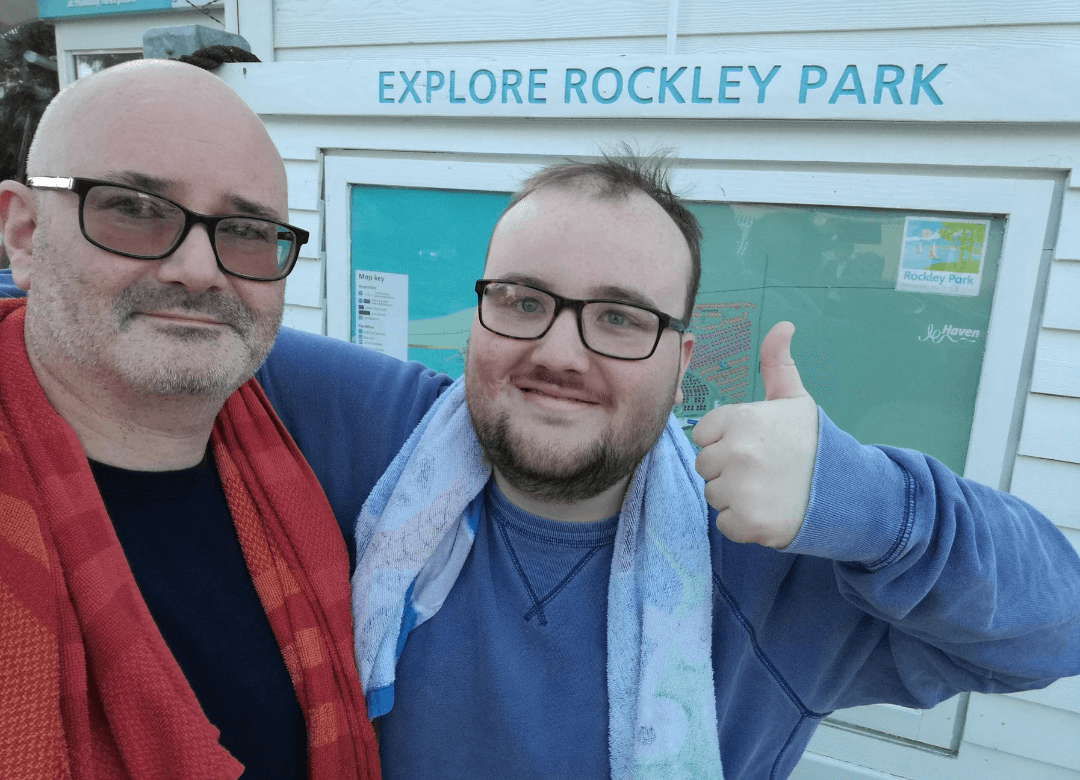
Eddie’s Dad, Joe, 50, says: “Despite his numerous health challenges, Eddie has an overwhelmingly happy disposition and optimistic outlook.”
Twice a week, he attends a community farm project and has a support worker who helps him with socialising and getting out and about. They go out a couple of times each week to swim or play snooker.
But unfortunately for the whole family, as Eddie has grown older, support has fallen away. The local council provide financial support towards Eddie’s support worker, but it was a long and difficult process to obtain this and there is very little available in advocacy services.
And support for Joe and Deb as carers has been sorely lacking despite the fact that Eddie is very vulnerable, cannot be left on his own and is unable to care for himself.
Joe says: “We are essentially left to get on with it and the Carer’s Allowance is a poor substitute for a proper wage, falling well below National Minimum Wage.”
The Sandcastle Trust’s support enabled the family to have a short break, which they otherwise would not have been able to afford.
Eddie’s older brother, Joe, is also on the Autistic Spectrum with a different range of health problems.
Dad, Joe, a civil servant, explains: “I reduced my working hours and my wife had to relinquish any career goals to care for our sons.
“The impact has been huge; we no longer go abroad on holiday, frequent plans and ‘normal’ family activities have to be cancelled as a consequence of poor health. We can’t take respite care because Eddie finds being with strangers very difficult.
“He gets anxious and stressed even if we’re out of the house for a few hours.
“My wife and I were looking forward to doing more as a couple, especially in later life, however, we’ve had to accept that our sons will be with us indefinitely.
“We sometimes feel depressed, frustrated, exhausted, overwhelmed and alone.
“And yet we maintain a positive outlook and try to cherish the good times.”
For the McEvoy’s, The Sandcastle Trust’s support was invaluable.
Joe says: “There is no age restriction in applying for a Sandcastle Memory which was brilliant for us.
“It was nice to spend time together as a family. Haven had an entertainment complex which wasn’t too busy, which ensured Eddie, who can easily get stressed in large, noisy crowds, was content.
“Eddie enjoyed playing in the pool and swimming. He was very happy and content, which meant we were too.
“Huge thanks to The Sandcastle Trust for a wonderful break and for making the whole application process so easy.”
Fraser’s Story
Amy Wilton, 36, is mum to Frazer, seven, who has the genetic condition late-infantile Batten Disease. They live in Torquay, Devon, with Frazer’s older brother Alfie, 11.
Amy said: “I had a completely normal pregnancy with Frazer, and he developed like any other baby. He hit all his milestones, he learned to walk and talk, and we had no concerns.
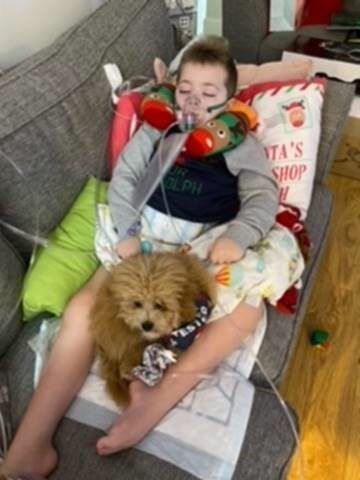
“But when he got to about three and a half he started to regress with his speech. He also started to develop symptoms similar to ADHD where his attention seemed to flit about and he’d have vacant spells where he’d stare into space.”
Frazer started speech and language therapy, but without much success, and by the time he’d turned four he began to have problems with his mobility and started falling over.
Amy explained: “Frazer started to have seizures, and experienced something called myoclonic jerks. It was like he’d had an electric shock, his legs and arms would jerk violently, to the extent he’d be thrown off the sofa.”
Frazer was at first diagnosed with epilepsy, but when medication didn’t improve his condition and he continued to suffer muscle spasms and seizures, doctors ordered further tests.
Frazer was eventually diagnosed with late-infantile Batten disease just after his fifth birthday.
The condition is caused by a mutation in the CLN2 gene, and just five or six children a year in the UK will receive a diagnosis.
The progressive, life limiting condition means that children will gradually lose their ability to walk, talk, play, see and speak.
Amy said: “I’d spent hours researching what could be wrong with Frazer on the internet, I’d read medical journals and academic papers, but I had never heard of this.
“You try and prepare yourself for the worst, but you never actually expect it to happen to your child. I was devastated when we found out what Frazer had, and that it has no cure.
“I collapsed in the corridor in the hospital and was then sick in the car park. It was my worst nightmare come true.”
The condition is extremely rare and is passed onto children from their parents, who both have a faulty gene. It is thought around 50 to 60 children in the UK are affected.
Amy said: “I was extremely worried that my older son Alfie would also have Batten disease, but he hasn’t shown any symptoms. He may be a carrier but he hasn’t inherited the illness like Frazer did.”
Frazer started attending school, but as his symptoms progressed he had to stop as he became overwhelmed and confused by the classroom and other children.
Instead he now receives therapy from a school for children with special educational needs at home twice a week, and the family have a team of night-time carers.
Days out, short breaks and festive trips to see Santa are now not possible as Frazer needs 24 hour care, so Amy turned to The Sandcastle Trust to help create an extra-special Christmas in their own home.
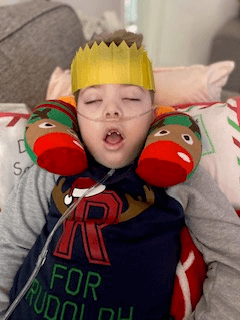
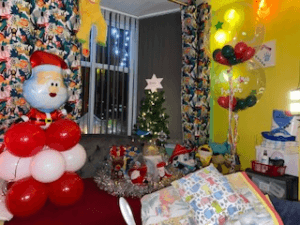
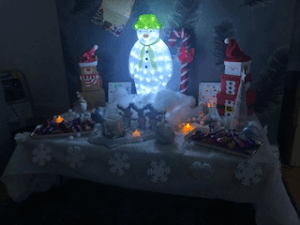
She explained: “Frazer loves anything about Christmas, and particularly the lights and music, so we decided to turn our house into a Christmas grotto. The Trust have provided us with illuminated models of the Snowman and Snowdog in the lounge, curtains made out of fairy lights, snowballs, a Christmas balloon arch, decorations which play music – the works.
“It’s wonderful to see Frazer in the grotto. He’s content and relaxed as the lights twinkle and the music plays.”
The Christmas fun continues outside in the garden, where the family have a snow machine, Christmas lights and a snowflake projector.
And older brother Alfie has not been forgotten, as the Trust provided him with a new laptop to enable him to keep up with his schoolwork and stay in touch with friends and family.
Amy said: “Alfie has had to grow up so much in the last couple of years, I’m so proud of him. He has seen trauma with his little brother that many adults will never have to go through, he knows how to use suction and give oxygen to Frazer.
“During lockdown we had to shield because of Frazer’s condition, so Alfie’s not been allowed to have any friends over. Having his own laptop means he can play games online with his friends and also keep up with all his homework.”
While Frazer’s exact prognosis is uncertain, children with Batten disease usually live to between eight and 12 years old. At the start of the year doctors told Amy to prepare that Frazer might not make it to the summer.
She said: “We were not expecting to be able to celebrate Christmas this year, so I’m very thankful that we can all be together. And to have such a magical grotto in our home that Frazer adores is an amazing gift.
“We don’t know if we’ll have another Christmas with Frazer, so spending time together and knowing that both the boys will really enjoy Christmas this year is very special.”

Josselin’s Story
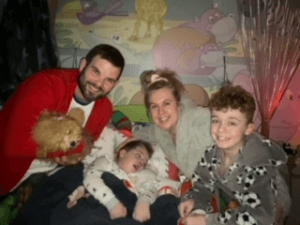
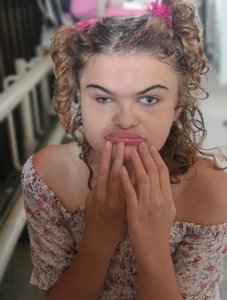
Karen Tilley, 40, is mum to Josselin, 14, who has the rare genetic condition CHARGE syndrome. They live near Bath with dad Lee, 43 and Josselin’s brothers Alex, 16 and Dalton, eight.
The family have been on several trips to see Santa courtesy of The Sandcastle Trust, but this year they’ll be having a festive family baking day with the Trust’s Christmas bake box.
Karen said: “Josselin is my second child, and I had no idea anything might be wrong until I went for a routine appointment towards the end of my pregnancy and the midwife said the baby’s heartbeat was very slow.
“As we were listening it began to go slower and slower until it stopped, and the rest is a blur. An ambulance was called and a surgical team was waiting for me at the hospital. I was given a general anaesthetic and when I woke up I had a new baby daughter.”
The family were told Josselin had a genetic condition after doctors noticed the pupil in her eye was keyhole-shaped.
Karen said: “We didn’t know anything more, but then Josselin began to get quite sick. We had diagnosis after diagnosis of different conditions, and we realised she was deaf and also blind.”
At six months old Josselin was diagnosed with CHARGE syndrome, which affects approximately 1 in 15,000 babies. The condition occurs when the CHD7 gene does not code correctly as an embryo grows, and results in a series of developmental issues with the brain, heart, eyes, ears and kidneys.
Karen said: “I had never heard of CHARGE syndrome and I had no idea what to expect. There was no social media when Josselin was a baby and I would spend hours in the evening on the internet, trying to find another child who had this condition. I wanted to know what children with CHARGE look like and what to expect for my baby, and back then I knew no-one at all in the same situation.
“Doctors knew very little about it either and relied on textbooks, and no-one could tell us if Josselin would ever be able to talk or walk.
“It was very isolating and I had to learn so much so quickly. It was a completely new world, and as Josselin was very poorly we constantly had a hospital bag packed. We seemed to be ringing the ambulance weekly as she had stopped breathing.”
With the advent of social media Karen was able to connect with other families, both in the UK and around the world, whose children also had CHARGE syndrome.
And as Josselin grew up she faced more challenges, but the family were able to put in place a routine to help them all adapt.
Karen said: “Josselin has quite severe learning difficulties and she cannot talk or walk, but she can bum shuffle to get herself around. She’s had more than 30 operations, one of which was a cochlear implant which means she can hear what is going on.
“She is tube fed but can take a few sips of water from a bottle and she has the cheekiest and most determined, mischievous personality. She loves to see how things work and constantly takes apart toys or games to get the workings out.
“I love to plan exciting trips and holidays to places and special days out, things people think a child like Josselin should not be able to do. We’ve been to France, Spain, Russia, Egypt and America. And this year we were planning a ski-ing trip.”
Josselin also attends a school for children with special educational needs and the family had a care plan with evening and night-time carers, as Josselin requires ventilation at night. They also had support from the local hospice.
But when lockdown hit this entire support network collapsed in an instant.
Karen said: “It takes a team of people to look after a child like Josselin, but suddenly we were on our own. It was horrendous.
“We couldn’t explain to Josselin why her entire routine had disappeared and she became more and more distressed. She began to refuse to get out of bed, and when we took her outside for activities she would shuffle back indoors, get back into bed and pull her duvet over her head. Her hips began to seize up as she was not doing any exercise and she started to pick at her skin until it bled.
“Doctors put her on antidepressants and antipsychotic medication, but all her anchor points and the activities she loved were gone.
“She had no speech and language therapy, no occupational therapy and no physiotherapy. They still haven’t re-started. We had to shield meaning we didn’t leave the house for months, except for short walks in her wheelchair. We felt completely isolated and abandoned.
“Josselin required my total attention, she has no sense of danger and could easily switch on the oven or injure herself. She would only sleep between 9am and 12 noon and I was utterly exhausted.
“My older son should have been doing his GCSEs and instead had to tutor himself through the online assessments his school set and complete them by himself. My younger boy missed months of homeschooling. The guilt I felt was unbearable.
“I was also terrified that Josselin might catch the virus and have to go to hospital on her own, or that I might catch it and I wouldn’t be able to look after her.”
As lockdown restrictions began to ease and Josselin’s school reopened the family were able to regain some sense of normality.
But activities and fun trips this year out have been limited by both Covid restrictions and finances.
Karen explained: “Just before lockdown I got a hospitality job, but once I realised we would have no care for Josselin I had to turn it down. We rely on my husband’s wage as a tattoo artist and family activities can be expensive.”
The family have been gifted a trip to see Santa several times before, thanks to The 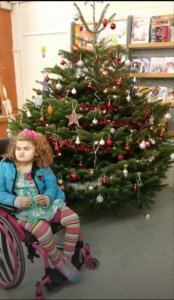 Sandcastle Trust, and as Covid restrictions prevent a visit to Father Christmas in 2020 they applied for a festive bake at home box instead.
Karen said: “Josselin adores Santa and all the magic of Christmas, and baking is something we can all do together at home.
“It’s also so heartening to know that we’ve not been forgotten and there is a charity out there who have thought of a way around all the restrictions to include children with profound disabilities, like Josselin.
“She will really enjoy helping to make the chocolate reindeer bake, and having some fun, festive time together making happy memories is something we all definitely need.”
Oliver’s Story
Oliver was born 7 weeks prematurely and had a difficult start in the NICU where he suffered a lung collapse and was on a ventilator for a while. When he recovered and came home it was hoped there would be no lasting effects from his early problems. However, it quickly became apparent that he was failing to thrive. Feeding was very difficult as he seemed to be unable to suck effectively and he had very bad reflux, at 6 months he weighed just 7lbs.
He underwent many tests at the hospital and had a feeding tube inserted. At 1 year old he only weighed 12lbs and was not sitting up or babbling at all and there were still no answers. Oliver did eventually sit up and began taking a few steps at 20 months but there was still no sign of any speech.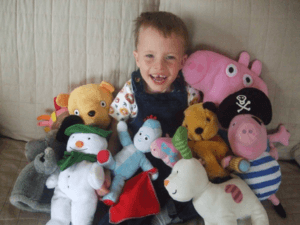
He underwent more tests and assessments and eventually at 2.5 years we were told he had a 6p25.3 duplication. We saw the geneticist and were shocked to find out that there were no other recorded cases of this anywhere and therefore they could give us no information on the condition, he truly was unique. The only thing they could do was put Oliver’s details on the decipher database of rare genetic disorders. It was a disappointing and confusing time as having found the probable cause of his problems we were now no closer to having any idea what the future would hold for him.
Over the coming 2 years Oliver had input from many therapists, paediatricians, dieticians and his portage worker. Feeding remained an ongoing issue as did speech as the muscles in his mouth and throat just did not seem to co-ordinate and function in the way they should.
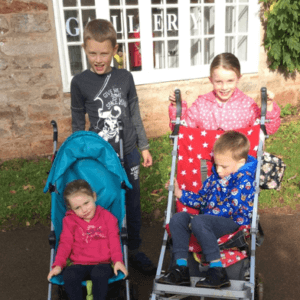
Now at nearly 5 years old he still cannot make sounds to form intelligible speech and has an electronic communication device as well as using makaton. He has sensory processing issues, many autistic features, developmental delays and is still dependent for all personal care and in nappies. His difficulties mean he has a lot of meltdowns and he can become very aggressive when he is upset. This can be very upsetting for his siblings and the time taken up dealing with Oliver puts a huge strain on the family, although we love him dearly. When he is happy he is very cheeky in his own little way and has a wicked sense of humour!
We were lucky enough to be awarded a grant from the Sandcastle Trust to see Santa this year which offered Oliver and his siblings some quality time for all to enjoy together which was really lovely.