
Josselin’s Story
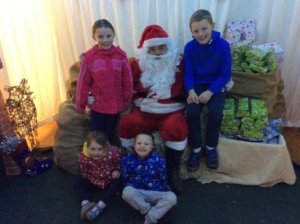
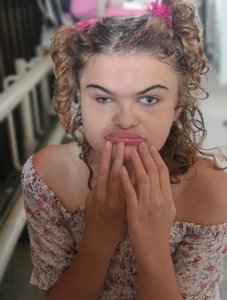
Karen Tilley, 40, is mum to Josselin, 14, who has the rare genetic condition CHARGE syndrome. They live near Bath with dad Lee, 43 and Josselin’s brothers Alex, 16 and Dalton, eight.
The family have been on several trips to see Santa courtesy of The Sandcastle Trust, but this year they’ll be having a festive family baking day with the Trust’s Christmas bake box.
Karen said: “Josselin is my second child, and I had no idea anything might be wrong until I went for a routine appointment towards the end of my pregnancy and the midwife said the baby’s heartbeat was very slow.
“As we were listening it began to go slower and slower until it stopped, and the rest is a blur. An ambulance was called and a surgical team was waiting for me at the hospital. I was given a general anaesthetic and when I woke up I had a new baby daughter.”
The family were told Josselin had a genetic condition after doctors noticed the pupil in her eye was keyhole-shaped.
Karen said: “We didn’t know anything more, but then Josselin began to get quite sick. We had diagnosis after diagnosis of different conditions, and we realised she was deaf and also blind.”
At six months old Josselin was diagnosed with CHARGE syndrome, which affects approximately 1 in 15,000 babies. The condition occurs when the CHD7 gene does not code correctly as an embryo grows, and results in a series of developmental issues with the brain, heart, eyes, ears and kidneys.
Karen said: “I had never heard of CHARGE syndrome and I had no idea what to expect. There was no social media when Josselin was a baby and I would spend hours in the evening on the internet, trying to find another child who had this condition. I wanted to know what children with CHARGE look like and what to expect for my baby, and back then I knew no-one at all in the same situation.
“Doctors knew very little about it either and relied on textbooks, and no-one could tell us if Josselin would ever be able to talk or walk.
“It was very isolating and I had to learn so much so quickly. It was a completely new world, and as Josselin was very poorly we constantly had a hospital bag packed. We seemed to be ringing the ambulance weekly as she had stopped breathing.”
With the advent of social media Karen was able to connect with other families, both in the UK and around the world, whose children also had CHARGE syndrome.
And as Josselin grew up she faced more challenges, but the family were able to put in place a routine to help them all adapt.
Karen said: “Josselin has quite severe learning difficulties and she cannot talk or walk, but she can bum shuffle to get herself around. She’s had more than 30 operations, one of which was a cochlear implant which means she can hear what is going on.
“She is tube fed but can take a few sips of water from a bottle and she has the cheekiest and most determined, mischievous personality. She loves to see how things work and constantly takes apart toys or games to get the workings out.
“I love to plan exciting trips and holidays to places and special days out, things people think a child like Josselin should not be able to do. We’ve been to France, Spain, Russia, Egypt and America. And this year we were planning a ski-ing trip.”
Josselin also attends a school for children with special educational needs and the family had a care plan with evening and night-time carers, as Josselin requires ventilation at night. They also had support from the local hospice.
But when lockdown hit this entire support network collapsed in an instant.
Karen said: “It takes a team of people to look after a child like Josselin, but suddenly we were on our own. It was horrendous.
“We couldn’t explain to Josselin why her entire routine had disappeared and she became more and more distressed. She began to refuse to get out of bed, and when we took her outside for activities she would shuffle back indoors, get back into bed and pull her duvet over her head. Her hips began to seize up as she was not doing any exercise and she started to pick at her skin until it bled.
“Doctors put her on antidepressants and antipsychotic medication, but all her anchor points and the activities she loved were gone.
“She had no speech and language therapy, no occupational therapy and no physiotherapy. They still haven’t re-started. We had to shield meaning we didn’t leave the house for months, except for short walks in her wheelchair. We felt completely isolated and abandoned.
“Josselin required my total attention, she has no sense of danger and could easily switch on the oven or injure herself. She would only sleep between 9am and 12 noon and I was utterly exhausted.
“My older son should have been doing his GCSEs and instead had to tutor himself through the online assessments his school set and complete them by himself. My younger boy missed months of homeschooling. The guilt I felt was unbearable.
“I was also terrified that Josselin might catch the virus and have to go to hospital on her own, or that I might catch it and I wouldn’t be able to look after her.”
As lockdown restrictions began to ease and Josselin’s school reopened the family were able to regain some sense of normality.
But activities and fun trips this year out have been limited by both Covid restrictions and finances.
Karen explained: “Just before lockdown I got a hospitality job, but once I realised we would have no care for Josselin I had to turn it down. We rely on my husband’s wage as a tattoo artist and family activities can be expensive.”
The family have been gifted a trip to see Santa several times before, thanks to The 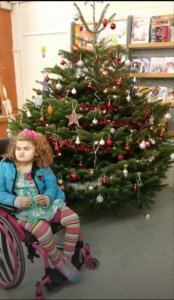 Sandcastle Trust, and as Covid restrictions prevent a visit to Father Christmas in 2020 they applied for a festive bake at home box instead.
Karen said: “Josselin adores Santa and all the magic of Christmas, and baking is something we can all do together at home.
“It’s also so heartening to know that we’ve not been forgotten and there is a charity out there who have thought of a way around all the restrictions to include children with profound disabilities, like Josselin.
“She will really enjoy helping to make the chocolate reindeer bake, and having some fun, festive time together making happy memories is something we all definitely need.”
Oliver’s Story
Oliver was born 7 weeks prematurely and had a difficult start in the NICU where he suffered a lung collapse and was on a ventilator for a while. When he recovered and came home it was hoped there would be no lasting effects from his early problems. However, it quickly became apparent that he was failing to thrive. Feeding was very difficult as he seemed to be unable to suck effectively and he had very bad reflux, at 6 months he weighed just 7lbs.
He underwent many tests at the hospital and had a feeding tube inserted. At 1 year old he only weighed 12lbs and was not sitting up or babbling at all and there were still no answers. Oliver did eventually sit up and began taking a few steps at 20 months but there was still no sign of any speech.
He underwent more tests and assessments and eventually at 2.5 years we were told he had a 6p25.3 duplication. We saw the geneticist and were shocked to find out that there were no other recorded cases of this anywhere and therefore they could give us no information on the condition, he truly was unique. The only thing they could do was put Oliver’s details on the decipher database of rare genetic disorders. It was a disappointing and confusing time as having found the probable cause of his problems we were now no closer to having any idea what the future would hold for him.
Over the coming 2 years Oliver had input from many therapists, paediatricians, dieticians and his portage worker. Feeding remained an ongoing issue as did speech as the muscles in his mouth and throat just did not seem to co-ordinate and function in the way they should.
Now at nearly 5 years old he still cannot make sounds to form intelligible speech and has an electronic communication device as well as using makaton. He has sensory processing issues, many autistic features, developmental delays and is still dependent for all personal care and in nappies. His difficulties mean he has a lot of meltdowns and he can become very aggressive when he is upset. This can be very upsetting for his siblings and the time taken up dealing with Oliver puts a huge strain on the family, although we love him dearly. When he is happy he is very cheeky in his own little way and has a wicked sense of humour!
We were lucky enough to be awarded a grant from the Sandcastle Trust to see Santa this year which offered Oliver and his siblings some quality time for all to enjoy together which was really lovely.