
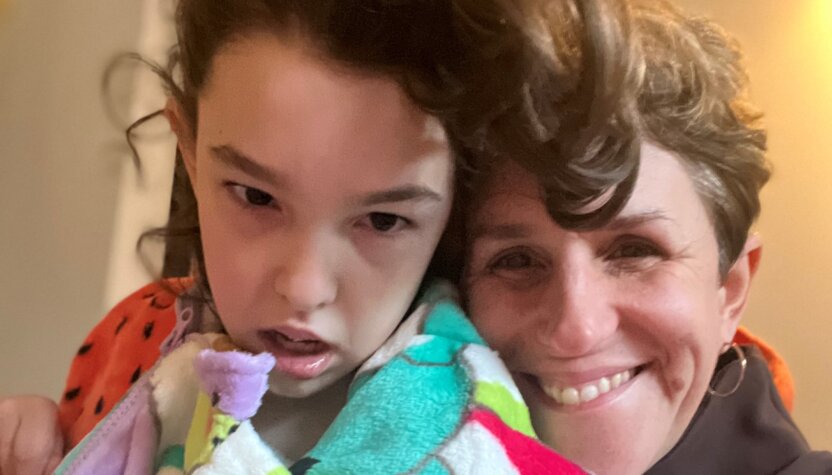
When Florence was diagnosed with a rare genetic condition, she was not expected to live until she was ten. She’s now 12 and her family are determined to enjoy every day they have with her. Precious memories were made last summer at one of our Sandcastle respite breaks in Wales.
Here mum Jenny describes the diagnosis that changed her world and the joy and challenges of life with Florence.
At the age of 18 months, Florence was taking her first steps, holding onto furniture, playing with her toys, babbling and saying ‘Mama’. It was shortly after, that mum Jenny East noticed Florence’s development tail off and then grind to a halt.
At the two-year check-up with a health visitor, Florence’s delay was flagged up, and she was referred to a consultant paediatrician.
 Jenny, 48, from Manchester, says: “There was nothing unusual about the pregnancy and birth and in the first year Florence seemed quite advanced for her age. But she didn’t progress from 18 months and then she regressed.”
Florence was diagnosed at the age of two with a very rare genetic condition called late infantile GM1 gangliosidosis. It is a genetic condition that progressively destroys nerve cells in the brain and spinal cord and is so rare it only affects 1 in 100,000 to 200,000 newborns. It is a severe and regressive condition, heartbreaking for parents as children gradually lose developmental skills. This means they lose the ability to walk, to talk, to sit unaided, support their heads and eat and swallow.
“The diagnosis was horrendous,” Jenny recalls. “Florence went for blood tests and brain scans, which were horrible as she had to be sedated. Our whole world was turned upside down. We were told to go home and make memories with her as she wouldn’t live past the age of ten. It has been regressive since she was diagnosed, so she can’t walk and she can’t sit up unaided. She used to crawl on her hands and knees, but she can’t now. She has a feeding tube in her stomach. She is non-verbal, but she can make herself understood. Florence takes medication for seizures and she is incontinent. She needs to be looked after 24/7.”
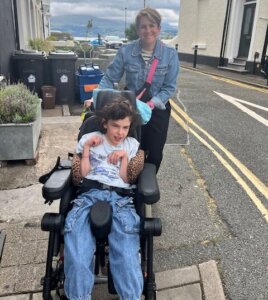 Jenny had genetic testing which showed she is a carrier of the faulty gene which causes GM1. It is usually carried by both parents, but Florence’s Dad hasn’t been tested, and the couple are now divorced. Florence’s 14-year-old brother Riccardo could be tested to see if he’s a carrier when he is 18.
In the early days, Jenny had a lot of contact with the GM1 Foundation in America, travelling to the US three times, fundraising and hoping for a cure for Florence. She narrowly missed out on a place on a preliminary clinical trial.
Jenny says: “There were only places for five children and Florence was the sixth. It was around the time that Covid hit, so looking back it was a blessing she didn’t get on the trial. I’ve made peace with that now and hope that one day in the future a cure will be available for all the children with GM1.
“As a parent, it hangs over you every single day, it’s an anticipatory grief. I am very accepting of the situation, and I’ve had a lot of counselling. We have moved to an accessible home to make everyday life easier. I think every day we have her with us is special. We are all about making memories. Looking back, we were told she wouldn’t live past the age of ten and now she has just turned 12!”
Jenny adds: “We have been well supported by a team – physio, OT, cranial osteopathy, and doctors. Some of that she has in school and some I have to pay for. Her special needs school is fantastic; she even has a hydrotherapy pool. Now she is not mobile at all, so she either uses a wheelchair or is on the floor. Fortunately, I can lift her as she is light, weighing 20kg, like a little doll. I have some respite care at home as Florence needs round the clock care. Riccardo is very good, helping out and he can cook tea.”
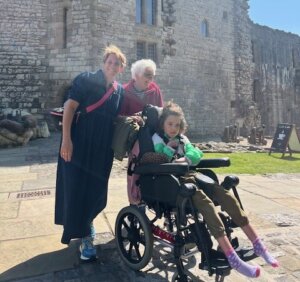 The family enjoyed a stay at The Sandcastle Trust’s caravan in Wales last summer, which is part of the Trust’s Family Respite Service provided for families just like Florence’s. Respite breaks give families the opportunity to spend quality time together in a fully accessible holiday caravan, giving them a break from the daily routine of caring and enabling families to refresh and reconnect.
Jenny says: “It was so pretty and lovely and everything was on site – two restaurants, a pub, a lake, a swimming pool, even a launderette. Riccardo swam every day and it was a lovely base for us to have a holiday. Mum came with me to help out. The fully adapted caravan was brilliant for Florence. Breaks away can be hard work, but it just made it all so manageable.
“Florence likes being out and about. She likes seeing different places. She likes going for walks. She is happy being surrounded by her family and people watching.”
Coping with a child with complex needs, who needs 24/7 care is of course challenging, as Jenny describes.
“It’s a rollercoaster ride,” Jenny explains. “It is mentally and physically hard, there’s mental anxiety, and we have been told what the future holds for Florence, but there are also good times. You have to accept it. The more I’m angry about it, the more it takes some of you away. You have an inner strength that you can find. I don’t have a choice but to cope, especially as a single parent.
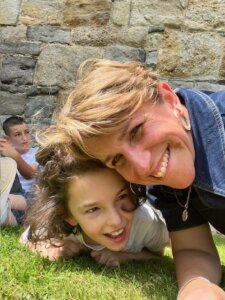 “In the meantime, life goes on for everybody else. Ricardo still deserves to have a life; I deserve to have a life and a career. I’m currently training to be a counsellor, and I’d like to work in child bereavement services.”
Jenny adds: “It’s hard to see photos when Florence was younger. It’s heart breaking. I won’t see her get married or have children, but you come to terms with that. They are still a little person. Florence is a gorgeous girl; she brings me joy and there is joy to be found in the everyday things. We give her the best opportunities that she can have.”