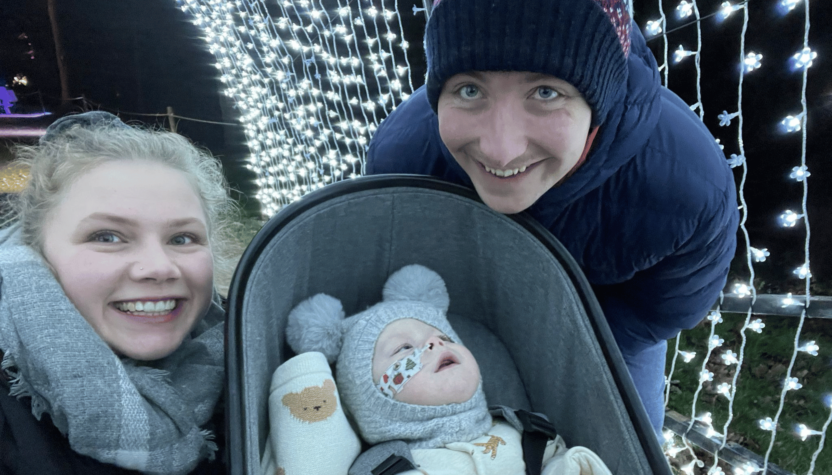
For parents Christie and Ashley Usher from Swindon, Wiltshire, their first year of parenting has been far from what they expected; overwhelming, stressful and facing the unknown, as their son Noah experienced multiple seizures, worrying health problems, trips to A&E and a devastating life-limiting diagnosis.
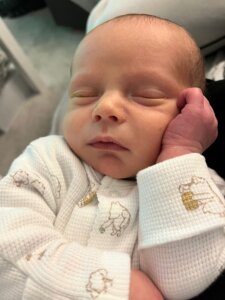 Noah had no obvious health problems at birth, but at five weeks old he had his first seizure at home. Once at A&E, hospital doctors weren’t sure it had been a seizure. He then had a total of 12 seizures in three days, and Mum Christie managed to capture some seizures on her phone to show doctors.
Christie, 30, explains: “Videos are crucial to show at hospital. The investigations were escalated and Noah had tests, scans and all the big scary causes were ruled out. Then the doctors thought it was meningitis as that made the most sense. Noah was in hospital for a week and discharged.
“As time went on, we noticed Noah wasn’t developing and we weren’t making any progress. He cried 24/7, struggled to feed and everything was difficult. At six months old I saw spasm type movements, which I filmed, and the GP thought were infantile spasms. A breakthrough came at a paediatrician’s clinic appointment, where a neurologist also had a clinic. He thought the spasms looked like dystonia and pushed for genetic testing. A month later he rang me and asked more questions about Noah and the chilblains on his feet. The consultant called back in May 2025; Noah was seven months old and he gave us the diagnosis of AGS1. There are variations and Noah’s is early onset, from birth.”
AGS 1 is a rare, inherited and severe genetic disorder which results in inflammation in the brain and other parts of the body. Children often have developmental delay, feeding difficulties, seizures, muscle stiffness, liver, spleen and skin problems like chilblains.
After diagnosis, the couple found out that Dad Ashley, 31, carries a dominant gene, which is very rare, as most children affected will inherit a faulty gene from both parents.
Coping with the diagnosis was overwhelming for the couple.
“You can’t really describe the emotion,” Christie says. “The best description is grief. We were told Noah would never walk, talk and probably not live until the age of ten, which is completely heart-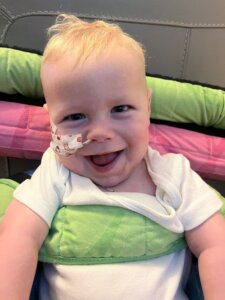 breaking. We tried for over a year to get pregnant, we had an image of our lives, and we didn’t see feeding tubes or assisted seating in that image. In the future we will need lifting equipment, hoists, adapted wheelchairs. It took us a while to adjust. Noah has no head control. He can’t sit or crawl. He has just started to reach but he can’t grab. He has a nasogastric feeding tube and is on the waiting list – it’s around a year wait – for a permanent feeding tube into the stomach. He is visually impaired, which is caused by interruptions in visual processing messages in the brain. He wants to be held 24/7 and fortunately he is small, around the size of a 6–9-month-old, so the lifting is ok. He takes medication for the seizures and his muscle tone.”
The couple are both supermarket assistant store managers and juggle their shifts around looking after Noah. They credit huge support from their families with their ability to cope, plus at home help from local hospice professionals. Noah sees a physiotherapist and an occupational therapist and Christie is learning how to help Noah’s development through play.
Through The Sandcastle Trust, Christie and Ashley each had one to one counselling to help them learn coping strategies.
“As a couple it is incredibly tough,” Christie explains. “With our work shifts we don’t see a lot of each other and that’s an incredible pressure. Ashley took on a lot of blame for it because it is his gene. We are still trying to figure it out and we give each other space. You have to be really understanding and communicate. It can be so isolating.
“Our six sessions each through Sandcastle were really good and we had them early on in the diagnostic process. It was so good to have that support when the diagnosis was so raw. My counsellor helped validate my feelings and it was beneficial for someone outside of the situation to say, ‘actually it is pretty awful, but look you are doing well!’”
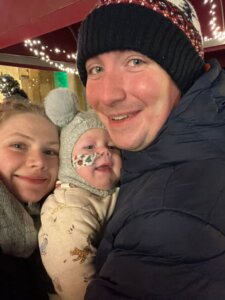 The family also enjoyed the Blenheim Palace Light Trail, as part of Sandcastle’s Santa Scheme, which helps families just like Noah’s make special memories.
Christie says: “It was fantastic, we loved it. We would never have done something like that without Sandcastle as leaving the house on a family day out can be overwhelming, especially when you need feeding tubes and syringes. It gave us a chance to be a normal family for the day.
“Looking back, the talking therapy was a godsend and was exactly what was needed, when we needed it. It gave us the tools to cope. When I see boys running around, I know that won’t be Noah, but I look at him and still see my gorgeous blonde boy. Now we are all about celebrating life and everything about him.”