Our Story
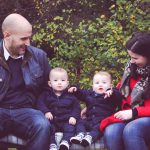
In 2009, at 28 years old Dave, my rugby playing, police officer husband started walking like he was drunk. On a holiday to Spain with friends, he suddenly lost the ability to wear flip flops, they would fly off his feet – it was the running joke of the holiday. Fast forward a few months and he started to have falls, walk with a limp and experience painful spasms in his legs. This was less funny – although we were still not overly concerned, he was young and apparently healthy, we thought perhaps a trapped nerve or a slipped disk was to blame.
What followed was the worst three years of our lives.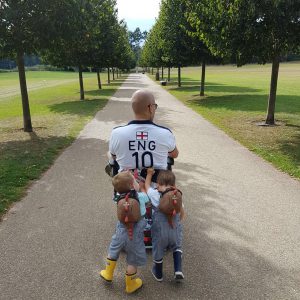
A report published by Rare Disease UK found that the average rare disease patient consults with five doctors, receives three misdiagnoses and waits four years for their final diagnosis. This was certainly our experience. Dave was subjected to appointment after appointment where various consultants would shrug their shoulders and an endless round of blood tests, MRIs, lumber punctures and nerve conduction studies. It was made clear to us that it was serious, neurological and degenerative – he wasn’t going to get better, in fact he was going to get a lot worse. Then came a series of misdiagnoses: First MS, then Primary Progressive MS, then Spastic Paraplegia and then PLS (a rare form of Motor Neuron Disease).
It was an awful, lonely time. We felt isolated and lived a day to day life of fear and uncertainty. We were frustrated and terrified.
Finally, in 2012 he received the formal diagnosis of Adrenomyleoneuropathy – a rare genetic neurological disorder. Even the consultant wasn’t expecting to give us a diagnosis that day. We had met him for another routine appointment and a print out of Dave’s latest blood tests which were handed to the consultant by a nurse during the appointment had thrown up the result. He stumbled over his words as he gave us the news and Googled the condition in front of us.
The initial feelings were those of relief. Finally, we knew what was going on, the exhausting battle to kick down every door and shout loud enough to get a definitive diagnosis was over and we could begin to access the help and support Dave desperately needed but was so difficult to obtain without a medical label. But the diagnosis also bought with it the reality of a potentially frightening prognosis and snatched our future away. This wasn’t meant to be part of the life we had planned together – we were newlyweds, had just purchased our first home, both enjoyed our jobs and were planning on travelling, having fun and then perhaps starting a family.
Whilst he was undiagnosed Dave and I would have long conversations where we fantasised about being told it was something temporary, a phase, treatable and would get better or change. That’s hard to do when you have a diagnosis and we went through a long period of grief, mourning the life we thought we were going to have. However, when the shock began to wear off, we entered a period of adjustment and started to look at things more practically. My own ignorance and prejudices surrounding disability initially prevented me from envisioning us ever having a happy family life but you learn to adapt, to assimilate and a future started to emerge albeit most definitely not the one we had planned or hoped for.
Four years on and Dave is spending increasing amounts of time in a wheelchair and lives with the uncertainty that for some people with his condition the prognosis is terminal. Despite the constant daily challenges he faces because of his condition, he still works full time, has become a father to twin boys and enjoys family life.
As time went on we began to learn more about Dave’s condition. He had a less aggressive adult onset form of a gene mutation that usually kills boys before the age of ten. The knowledge that he may not have had a childhood and the opportunity to have a family, made Dave determined not to be overcome with fear about what might happen in the future, to make the best of each day – focus on the happy moments and not let disability be a barrier to experiencing everything that life has to offer and that included enjoying time together as a family.
This however, proved easier said than done. We quickly realised that Dave’s condition would mean we would have to navigate all manner of physical challenges when planning days out or holidays for our family. We began to think about how much harder it must be for other families in the rare genetic condition community to access much needed fun and respite – those that were unable to continue working following theirs of their child’s diagnosis, or those that have several children with the same diagnosis, for example.
That is where the idea of the Sandcastle Trust comes from. The physical emotional and financial strain of having a loved one with a rare genetic condition can often tear families apart. We hope to help other families like ours access holistic respite improving health, wellbeing, happiness and quality of life.
Christopher’s Story
Jean Hubberstey’s youngest son Christopher, lives with the rare genetic condition Bardet-Biedl syndrome (BBS). It’s an inherited genetic condition which causes vision loss, obesity, kidney abnormalities, mobility issues and learning difficulties.
Jean and her husband David were no strangers to coping with such a devasting diagnosis. They unknowingly carry a gene alteration on chromosome 16, and whilst their eldest two sons were born healthy, they tragically lost their third son Paul to kidney failure, a result of BBS. Paul was just three years old and died in 1988. Christopher was born three years later, and by the time he was six his kidneys were failing.
“It was like déjà vu,” Jean says. “We’d been through this all before, with the same hospital consultant. I knew when Christopher was six weeks old, and wasn’t thriving, that there was something wrong. He was our fourth baby and although he didn’t feed that much, he was vastly overweight.
“With BBS you are guaranteed to get kidney failure, which Christopher had, and he needed dialysis. The consultant said it couldn’t be a coincidence having two sons with kidney failure so referred him to the genetic consultant who came up with BBS. Christopher had a kidney transplant aged eight and that transplant is keeping him alive today.”
Christopher is now 34 and despite complex medical needs, including complete loss of sight, diabetes and liver and kidney disease, he lives a fulfilling, busy life and is thriving. He has a girlfriend, whom he met at school,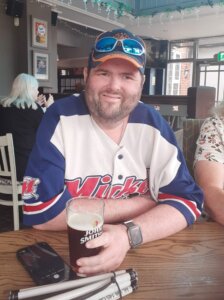 and he enjoys attending both a day centre and a visual impairment centre. His main passions are going to tribute acts and musical theatre shows in Blackpool. Christopher lives with his parents and has daily carers who Jean describes as “brilliant”.
The challenge is that now his parents are both 74, they have their own health issues and are still needed to drive to hospital appointments and cope with the physical and emotional challenges of looking after an adult child with complex needs.
Jean explains: “For us it becomes more challenging as Christopher gets older, and we get older. We do everything for him, but what can we do? I’ve had a stressful life, but I think you learn to cope with it. I’ve been coping with this condition for 40 years and it wears you out. I feel I’ve aged 20 years in the last year. I’m waiting for two operations – an eye operation and a hernia repair. I have arthritis in my hands and feet and can hardly walk. It is such hard work to keep going.
“BBS is a disease of the cilia and affects every part of the body, so Chris has many medical conditions. It also makes Chris more susceptible to infection and sepsis. This summer he was really unwell, with the Epstein Barr Virus and a rash all over. That was hard. The difficulty is if Chris feels ill, he doesn’t tell anyone, he doesn’t speak up for himself. Over the years I’ve stayed in hospital with him for months and months. I wouldn’t leave him. I left Paul for one night and he died that night whilst I was away. I have to live with that.”
Christopher has had many health scares Jean thought he would not survive. He had COPD and was on oxygen at night, he’s survived sepsis TWICE, plus he used to have seizures whilst having dialysis.
Jean says: “As far as life expectancy goes, he has liver fibrosis, and we know he won’t live until he is 40 because he has so many health complications. I don’t know how he survived sepsis, but he did. We make the most of every day, we take Christopher on day trips and to the theatre. Christopher loves to be on holiday and comes alive then when he’s away.”
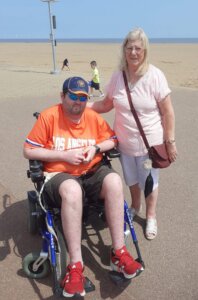 This summer, the family enjoyed a holiday at the Sandcastle Trust’s fully adapted holiday caravan in Skegness. It is provided as part of ‘Sandcastle Memories’, the Trust’s programme offering respite days out and away breaks for families living with a rare genetic condition.
“We had a lovely weekend in Skegness,” says Jean. “It was sunny all the way through, we picked the best week. We took Chris’ electric wheelchair because he is too heavy to push in a manual wheelchair, and he wants to be independent. Everything was adapted in the caravan for wheelchair users.
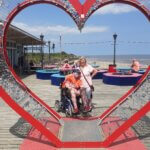
“We went to the pier, went to the market and sat on the promenade. It wasn’t crowded on the pier and Christopher loved that, as he could drive his wheelchair easily and feel free. For us, it was a much need break. When you care for years and years it wears you down, grinds you down both physically and mentally. It’s a big expense too; I don’t get paid and we live on a basic pension. You do need a holiday. We really relaxed on this holiday; there was no getting up and ready for the carers and no hospital appointments. It felt like we calmed down and took a real break.”
Archie’s Story
Paige Newell-White knows all too well the emotional and physical stress of caring for a child with a rare genetic condition. Her son Archie, three, is a fun-loving, Hot Wheels collecting, smiley little boy who loves nothing more than splashing in a swimming pool. But at the age of 17 months he was diagnosed with Angelman Syndrome, a rare genetic condition. Paige describes the process of battling to get a diagnosis, coping with his care and the ensuing emotional strain as a ‘grieving process’.
“The diagnostic process takes you through all the stages of grief,” Paige explains. “I first took him to the GP when he was six months old, he wasn’t sitting up and he wanted to sleep all the time. He was in and out of hospital with repeated infections, caused by aspirating on liquids. I was just put down as an over-anxious first-time mum. Archie wasn’t seen by a paediatrician until he was one. By this time, he was the size of a child half his age and had dropped off the weight charts. He was only just trying to roll over and not reaching for things. He also suffered from absence seizures.”
Paige and husband Connor White, both 27 and from County Durham, were worried sick and it was a battle to get the paediatric referral.
The paediatrician said Archie had global developmental delay and low muscle tone down his left side. After genetic testing, Archie was diagnosed with Angelman Syndrome (AS), a very rare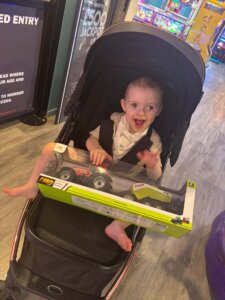 genetic condition which affects the nervous system. It is caused by a change or deletion in the UBE3A gene located on chromosome 15. Children can experience seizures, global developmental delays, speech delays and mobility issues.
Paige says: “I’d prepared myself for something bad to come back from the tests, but the way we were told was quite hard – we were told he had AS and given some leaflets. It was a huge shock.”
Archie’s gene deletion is small, below the average, which means with physical therapy his development has progressed since his diagnosis. But his epilepsy has become life threatening.
“In January 2025, we nearly lost him when he had seven prolonged seizures in 12 hours,” Paige explains. “We knew his epilepsy would get worse, we were prepared, but that doesn’t make it easier to cope with. Now Archie is three he has many additional needs: he crawls at home, but he can’t walk and so we use a wheelchair or pushchair outside. He can’t swallow liquids as he will aspirate them, so foods must be thickened. He has bad separation anxiety and will scream if he can’t touch me if I’m in the same room. If he can’t see me, he’s fine.
“He is non-verbal, but he can still communicate his needs. His behaviour can be difficult, and he bites me, he also has sensory issues and can’t stand anything on his face. We are waiting for eye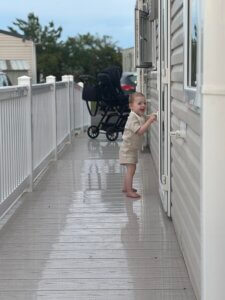 surgery for an eye condition called nystagmus, but so far, we’ve waited two years. He doesn’t sleep – he can go a whole week on one hour’s sleep, so we take the night in shifts. He has no sense of danger and must be supervised 24/7. With a ‘normal’ toddler you can nip to the toilet, but not with Archie, you have to have eyes on him all the time. It’s too much for the Grandparents to look after him, they worry about the seizures, but that means we don’t get a break.”
Paige adds: “I struggled for a long time; I got severely depressed. I spent a lot of the last year angry and hurt. I had to leave my job as a support worker with adults with learning disabilities in October 2024, as it was just too much to cope with. Friends have been supportive, and private therapy has helped. Thankfully our Council funded that. I’m lucky Connor works from home as an IT engineer, so he’s there if I’m struggling, and we have a childminder for one day a week, but we don’t get much time together as a couple.
“Emotionally it’s like a grieving process. When I was pregnant, I imagined what type of person he’d be, what kind of job he would do. Now I worry will he ever walk? How will he manage at school?”
Holidays have their own challenges when caring for a child with a rare genetic condition. Last year the family went to Berwick-Upon-Tweed but had to return home early as Archie was ill, and with his history of seizures they couldn’t risk being an hour’s drive from the nearest children’s A&E hospital in Edinburgh.
In 2025 the couple applied to stay at the Sandcastle Trust’s fully adapted holiday caravan in Skegness, which is part of ‘Sandcastle Memories’, the charity’s programme offering respite days out and away breaks for families living with a rare genetic condition.
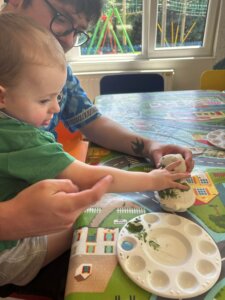 Paige says: “We had a fantastic holiday in June, it helped us as a family massively. It gave us a chance to slow down and spend quality time together. Looking after a child with a genetic condition is a financial strain too and this year we just wouldn’t have been able to afford a holiday. Being away, it was great to have a break from hospital and physio appointments as we have up to eight appointments a week at home and they’re exhausting.
“The caravan was safe for Archie, there was nothing he could hurt himself on, which meant that we could spend time together there properly relaxing. The design of the caravan meant that Archie could play and wherever he was he could still be watched.
“We enjoyed a few days out, including the Aquarium, did pottery, painting and spent a lot of time swimming – he is water obsessed – and he also loved the wet room bathroom. We all loved the family time together.”
Harry’s Story
Harry Degiorgio’s first birthday should have been a fun filled day with family, cake, balloons and presents. But instead, Harry woke up on the morning of his birthday in a hospital bed after an hour-long seizure. Worse was to come a few weeks later when little Harry had ten seizures in 72 hours. The fear and unpredictability of these life-threatening seizures left parents Beth and Craig Degiorgio, from Solihull, West Midlands, feeling their family life was lived on a knife edge.
“It felt like we’d get home from hospital and then bang, it would happen again,” Beth, 34, explains. “Those three days of seizures were hell. Harry had been diagnosed with infantile epilepsy months before and started on medication, but we knew something really wasn’t right at all. When we left hospital, we saw at the bottom of the discharge letter ‘query Dravet Syndrome?’ We had never heard of it, and none of the doctors had mentioned it to us. We had to google what it was. Weeks later we all had genetic testing and just had to wait for the results.”
It was when Harry was just four months old that he had what doctors said was a febrile convulsion, after a routine vaccination. At hospital, a consultant reassured the family, but also advised them if Harry did have another one, they should film it.
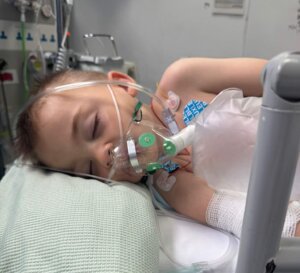 Harry had two more seizures over the next few months and Beth filmed those, which provided doctors with a clear record of the type of seizures. Tests and an MRI followed, and Harry was given medication to control infantile epilepsy, plus rescue medication.
“It was terrifying and traumatic, but we were of the belief that he would grow out it, and we’d deal with it,” Beth, who is also Mum to Tilly, now seven, recalls. “The summer of 2022 Harry had no seizures, but he wasn’t quite where he needed to be developmentally. His balance wasn’t great, and he would fall backwards to one side when sitting up. Then in the Autumn, Harry turned one and we were in and out of Birmingham Children’s Hospital. Then followed a bad Christmas and New Year with seizures.
“I describe the seizures as a monster that followed us around. We’d think ‘should we go to that place or event?’ Are we doing something that will be a trigger for seizures? You are constantly playing a worst-case scenario in your mind. Every seizure had been induced by a virus, but our daughter Tilly was in nursery and going on playdates, so that was hard. We wanted to make sure she had a normal childhood too. Tiredness was also a trigger for seizures and Harry didn’t sleep.”
The diagnosis came in January 2023 in a phone call to Beth’s office.
Beth recalls: “The consultant told me the genetic tests were positive for Dravet Syndrome. We were offered a follow-up appointment with Harry’s consultant and epilepsy nurse. In that moment, standing outside my office, my world fell apart. It was in his DNA. I don’t remember the rest of the phone call. I walked back into the office and I broke down. At home I was sobbing. You go into shock. Life had changed forever.”
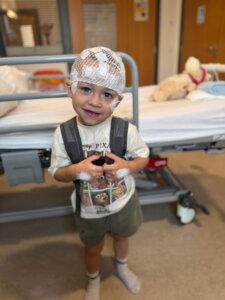 Dravet Syndrome is a life-limiting genetic condition, caused by a change in the SCN1A gene. Harry’s alteration is ‘de novo’, meaning it was not inherited. Symptoms include seizures and a range of comorbidities, including severe sleep disorder, which Harry also has. It affects one in 15,000 babies born in the UK. There is no cure, and the epileptic seizures are extremely hard to treat as the Degiorgio family discovered.
Beth explains: “The medications stopped working. We entered a Dravet world of many hospital appointments. We watched our child start to walk, learn a new skill and then lose it again after a seizure. One was so bad he had to be resuscitated. One in five children with Dravet won’t make it to adulthood. It is a life-changing, horrible condition.
Beth continues: “Harry spent his second birthday having a seizure and the paramedics came out. We’d got to a point where Harry was having up to four seizures a week and two hospital stays a month. We were beyond lucky with our family support – and we trained them in using rescue medications – but as parents, you’re not mentally prepared for it. You try to balance work and normal life and feel guilt and shame if it happens when you’re not with your child.
“It affects every aspect of our lives, both of us as parents were experiencing trauma but in different ways, I was mainly heading up Harry’s medical care and dealing with that which was demanding and stressful, however Craig was having to go to work, knowing he had to miss appointments and being in hospital with Harry, to ensure he was earning money to keep us afloat which takes its toll on him. On top of that we are both sleep deprived and having to watch our child suffer so much with the seizures and that takes a big toll on your relationship.
“You face all the ups and downs of it and that’s counterbalanced by an amazing child that you’re caring for. I wasn’t sleeping – melatonin helped Harry get to sleep, but he would wake up in the night and wake us up. At this point, I felt I wasn’t coping very well. I was anxiety ridden. It is a big step to accept you need help.”
Beth’s GP offered anti-depressants and when Beth refused them, she was contacted by a counsellor who she spoke with for around half an hour, explaining Harry’s condition. The counsellor then sent Beth links to YouTube videos on cognitive behaviour therapy techniques and offered no further sessions.
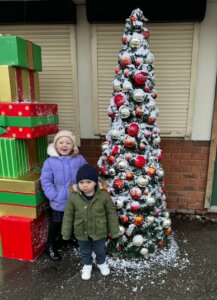 “That was all the NHS offered,” Beth says. “We’d heard of The Sandcastle Trust because we’d been fortunate enough to have a ‘Sandcastle Santa Day’ gifted by them over Christmas 2023. It was a really great day out meeting Santa at Drayton Manor. Special days out are great and to know that day has been gifted to you is amazing. I saw in a newsletter the Trust was providing counselling and I applied.”
In the Summer of 2024, Beth started counselling sessions over Zoom. Through counselling she was given tools which help her cope with everyday challenges, anxieties and fears for the future.
Beth says: “Before the counselling I felt grief, anger, trauma and resentment at the diagnosis and what it was doing to our children, and I know Craig felt guilty that he had to go to work. I felt pressure and didn’t know how we would cope. A genetic condition has an impact on the whole family, the parents, who are already sleep deprived and have to be ready to act in an emergency, and the siblings.
“Counselling helped me deal with those overwhelming feelings and emotions. It helped keep me going. We refer to it as a big purple monster that sits in the corner of the room but now we acknowledge it is there and we just ask it to stay there so we can carry on. Sometimes it will come and wipe us out. Counselling doesn’t magic it better, but it gives you an understanding of how to find a way of living with it, how to focus on the things we can control and way to manage the things we can’t. After six months of sessions, I still had all the trauma and responsibility, but I had coping mechanisms.
“Now I can find the hope, see the small milestones and appreciate them and see how fortunate we are. I am so grateful to The Sandcastle Trust for the counselling sessions.”
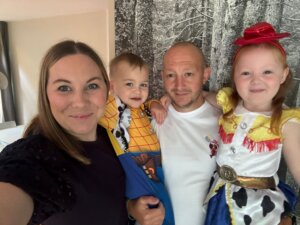 Harry is now four years old and reached a huge milestone in starting nursery a few mornings a week, building up gradually before Reception class, where they hope he will have a one-to-one assistant. Beth admits she has days where, “the cloud is big and heavy” but with the skills she’s learnt during counselling she recognises negative feelings and works them through.
“We are now in a really good space,” says Beth. “We celebrate the wins. Harry has had 100 days without big seizures. He’s making friends at nursery, he loves any ball games, and he is so loving. He is incredible and he’s made us better parents and people.”
Beth shared their family’s experiences as part of our 2025 Christmas Appeal film, which you can watch below
Ruairi’s story
Like most 28-year-olds Ruairi Corr wants to live an active life, travel independently and enjoy new experiences. Ruairi loves swimming, hiking, mountain climbing and has even been sky diving – all incredible as Ruairi has the rare genetic condition adrenoleukodystrophy (ALD) and is registered blind, hearing impaired and has epilepsy.
Despite his complex needs, Ruairi, who lives with parents Deirdre, 62, and Aaron, 61, in Exmouth, Devon, was eager to go away on a holiday without his parents. The family applied for the Sandcastle Trust’s programme Sandcastle Memories, which offers respite for families living with a rare genetic condition, in the form of UK breaks and days out.
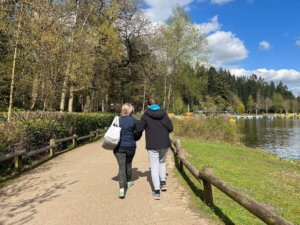
The Sandcastle Trust was delighted to be able to grant Ruairi a trip to Center Parcs Longleat Forest, where – always accompanied by two carers – he had a fantastic time in the swimming pool, the spa and walking in the forests.
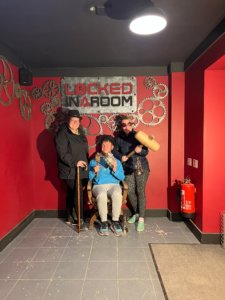
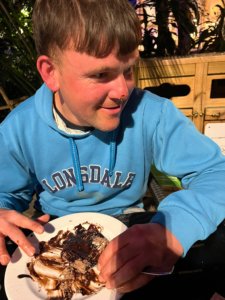
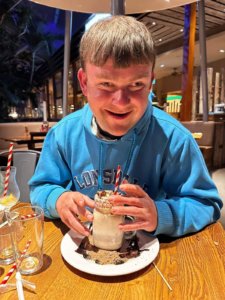 “Ruairi absolutely loved Center Parcs,” says his mum Deirdre. “He enjoyed the swimming so much and went up and down the rapids repeatedly. He had massages, which relax him and loved the spa and jacuzzi hot tub. He did so much walking his carers kept getting lost, which he thought was very funny. His favourite place to eat was the Pancake House, where he had fabulous pancakes filled with cream and chocolate. He also did an ‘escape room’ activity. It is all brilliant for his fitness and he thrives on being active and busy. We can’t thank the Sandcastle Trust enough.”
Ruairi’s diagnosis came at the age of five when the family received the devastating news that not only Ruairi, but also his younger brother Tom, who was four, had ALD. ALD is a very rare, inherited genetic condition that causes the build-up of very long chain fatty acids in the brain. This build-up destroys myelin, the protective sheath that surrounds the brain’s neurons, which are the nerve cells that allow us to think and to control our muscles.
Only boys are affected, with mothers often carriers, as was the case for Deirdre, who has mobility difficulties herself. The first sign is that healthy boys start to regress, followed by deafness, blindness, seizures and loss of muscle control. For Ruairi the first signs came around the age of five when he developed processing issues, was diagnosed as being on the autistic spectrum, and was then hospitalised with adrenal problems.
“When the boys were diagnosed we were living in Ireland and we were told it was a terminal illness,” explains Deirdre. “I started researching ALD and found a specialist doctor in Bristol and found out a bone marrow transplant could halt the symptoms. We were initially refused the transplant for Ruairi, when he was six, whereas Tom, then aged five, was at the right stage. We persuaded the doctor to repeat the tests for Ruairi and the consultant agreed to the transplant, whilst warning us the future could be bleak and we had three other young children to look after.”
The bone marrow was donated for transplant by big sister Aisling, who was aged seven. It saved the boys’ lives, but it took 12-18 months to take effect and, in that time, Ruairi lost his sight and his hearing. The treatment was successful for Tom and he is healthy.
When Ruairi was seven the family decided on a major life change, moving to Exmouth so Ruairi could attend a school for the blind in Exeter. Over the years his brother and two sisters went on to live independent lives, something Ruairi found difficult to cope with. With lots of energy and physically fit Ruairi was eager to enjoy new experiences, including going on holiday.
Deirdre says: “Ruairi has carers 24/7 and can’t do anything alone. He says he’d love to be able to walk out the front door on his own and say, ‘see you later’. He is so aware of what is going on and it makes it difficult for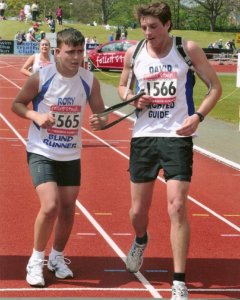 him. He thrives on being busy. Ruairi volunteers once a week at a horticultural centre and he has turned our back lawn into a mint garden, which he loves as he has a heightened sense of smell. His carers have become friends of the family; he bakes with one, one carer does woodwork and another is a yoga teacher. He uses an adapted bike to take part in virtual cycles; he has climbed the Three Peaks and Carrauntoohil, the highest mountain in Ireland, a real challenge as streams and rocks are hard when you can’t see. For his 21st birthday he did a sky dive, accompanied by his sister who is a nurse!
“Going to Centre Parcs has had a huge impact on Ruairi’s wellbeing. He came back so happy and wanting to tell us all about it. He gets on so well with his carers – they can have a laugh. The break really lifted his mood and had a positive effect on his mental health. He looks a lot better for the break; brighter, happier and a better colour. It makes him feel like he has an independent life like his siblings.”
Noah’s story
For parents Christie and Ashley Usher from Swindon, Wiltshire, their first year of parenting has been far from what they expected; overwhelming, stressful and facing the unknown, as their son Noah experienced multiple seizures, worrying health problems, trips to A&E and a devastating life-limiting diagnosis.
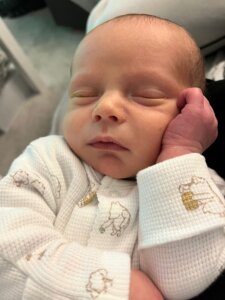 Noah had no obvious health problems at birth, but at five weeks old he had his first seizure at home. Once at A&E, hospital doctors weren’t sure it had been a seizure. He then had a total of 12 seizures in three days, and Mum Christie managed to capture some seizures on her phone to show doctors.
Christie, 30, explains: “Videos are crucial to show at hospital. The investigations were escalated and Noah had tests, scans and all the big scary causes were ruled out. Then the doctors thought it was meningitis as that made the most sense. Noah was in hospital for a week and discharged.
“As time went on, we noticed Noah wasn’t developing and we weren’t making any progress. He cried 24/7, struggled to feed and everything was difficult. At six months old I saw spasm type movements, which I filmed, and the GP thought were infantile spasms. A breakthrough came at a paediatrician’s clinic appointment, where a neurologist also had a clinic. He thought the spasms looked like dystonia and pushed for genetic testing. A month later he rang me and asked more questions about Noah and the chilblains on his feet. The consultant called back in May 2025; Noah was seven months old and he gave us the diagnosis of AGS1. There are variations and Noah’s is early onset, from birth.”
AGS 1 is a rare, inherited and severe genetic disorder which results in inflammation in the brain and other parts of the body. Children often have developmental delay, feeding difficulties, seizures, muscle stiffness, liver, spleen and skin problems like chilblains.
After diagnosis, the couple found out that Dad Ashley, 31, carries a dominant gene, which is very rare, as most children affected will inherit a faulty gene from both parents.
Coping with the diagnosis was overwhelming for the couple.
“You can’t really describe the emotion,” Christie says. “The best description is grief. We were told Noah would never walk, talk and probably not live until the age of ten, which is completely heart-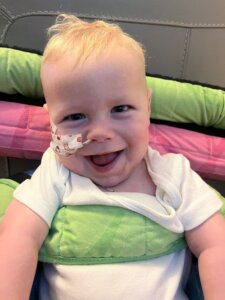 breaking. We tried for over a year to get pregnant, we had an image of our lives, and we didn’t see feeding tubes or assisted seating in that image. In the future we will need lifting equipment, hoists, adapted wheelchairs. It took us a while to adjust. Noah has no head control. He can’t sit or crawl. He has just started to reach but he can’t grab. He has a nasogastric feeding tube and is on the waiting list – it’s around a year wait – for a permanent feeding tube into the stomach. He is visually impaired, which is caused by interruptions in visual processing messages in the brain. He wants to be held 24/7 and fortunately he is small, around the size of a 6–9-month-old, so the lifting is ok. He takes medication for the seizures and his muscle tone.”
The couple are both supermarket assistant store managers and juggle their shifts around looking after Noah. They credit huge support from their families with their ability to cope, plus at home help from local hospice professionals. Noah sees a physiotherapist and an occupational therapist and Christie is learning how to help Noah’s development through play.
Through The Sandcastle Trust, Christie and Ashley each had one to one counselling to help them learn coping strategies.
“As a couple it is incredibly tough,” Christie explains. “With our work shifts we don’t see a lot of each other and that’s an incredible pressure. Ashley took on a lot of blame for it because it is his gene. We are still trying to figure it out and we give each other space. You have to be really understanding and communicate. It can be so isolating.
“Our six sessions each through Sandcastle were really good and we had them early on in the diagnostic process. It was so good to have that support when the diagnosis was so raw. My counsellor helped validate my feelings and it was beneficial for someone outside of the situation to say, ‘actually it is pretty awful, but look you are doing well!’”
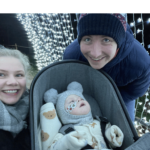
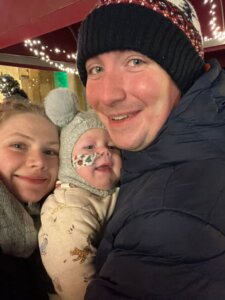 The family also enjoyed the Blenheim Palace Light Trail, as part of Sandcastle’s Santa Scheme, which helps families just like Noah’s make special memories.
Christie says: “It was fantastic, we loved it. We would never have done something like that without Sandcastle as leaving the house on a family day out can be overwhelming, especially when you need feeding tubes and syringes. It gave us a chance to be a normal family for the day.
“Looking back, the talking therapy was a godsend and was exactly what was needed, when we needed it. It gave us the tools to cope. When I see boys running around, I know that won’t be Noah, but I look at him and still see my gorgeous blonde boy. Now we are all about celebrating life and everything about him.”

Ivan’s story
Three-year-old Ivan Novak was born with the very rare genetic condition Phelan McDermid syndrome (PMS) which affects development, mobility, speech, digestion and shares similarities with autism.
Ivan’s parents Elissa, 32 and Joe, 33, first became concerned when Ivan – their only child – was seven-months-old and was delayed reaching milestones.
 “It was during the first lockdown and no one would see him,” Elissa, from Nuneaton, Warwickshire, recalls. “He then had a big regression around the age of one, following a hand, foot and mouth infection. He lost the words he had, like Momma and Dadda, and his mobility. He regained some skills, although still non-verbal, before regressing again aged two, which is when we got the diagnosis.”
Ivan’s genetic condition affects every area of his life, and he has around ten doctors and practitioners involved in his regular care. He has low muscle tone which affects his fine and gross motor skills, and he is unable to gesture or point. This makes communication difficult for him which is understandably frustrating. He struggles with balance and spatial awareness, which along with low muscle tone causes him to fall and tire quickly. He can walk with assistance.
The biggest problem Ivan faces is with his digestive system. He needs weekly enemas to pass a bowel movement, but these have to be administered in A&E as the funding for community care has been cut. Ivan vomits frequently, which can pose a choking risk and has resulted in weight loss. He now weighs just 11kg. Ivan has needed long stays in hospital and has shown signs of trauma.
Elissa explains: “This last year has been difficult. In Autumn 2022 Ivan spent seven weeks in hospital for pain related to fluid on the brain and sudden seizures. 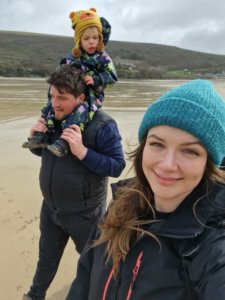 Then a week after he came home, sadly my Mum passed away. All of a sudden, his grandma was gone from his life and he became very withdrawn. He was having a trauma reaction. He didn’t want to play or do anything at all. All he would do was listen to Waiting On A Miracle, the sad song from the film Encanto.”
The Sandcastle Trust wanted to help Elissa and Joe create special memories with Ivan through their programme Sandcastle Memories, which offers respite for families living with a rare genetic condition, in the form of UK breaks and days out.
The charity arranged for a week’s stay in March 2023 at the Cowries St Merryn holiday home in Padstow, Cornwall. The break away proved to be a real tonic for Ivan.
After the long drive he went straight upstairs and curled up on a bed with a teddy and fell asleep,” Elissa says. “He was so relaxed in the holiday home. Having not been mobile Ivan started walking on the beaches and he has stayed walking since. One third of Ivan’s life has been spent in pain and distress, with many hospital stays. It is horrible and it is hard to go through, but to see Ivan feeling better and having fun was just brilliant.”
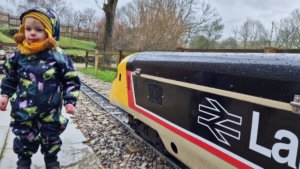 Whilst in Cornwall the family went on a visit to a farm, Ivan took part in jam tasting and discovered he loved fudge. They particularly enjoyed the beaches, Padstow and relaxing in the house.
“We all felt a lot better after the break. We spent family time together and it was relaxing. That time together makes a huge difference to our ability to cope with the condition.”

Florence’s Story
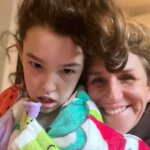
When Florence was diagnosed with a rare genetic condition, she was not expected to live until she was ten. She’s now 12 and her family are determined to enjoy every day they have with her. Precious memories were made last summer at one of our Sandcastle respite breaks in Wales.
Here mum Jenny describes the diagnosis that changed her world and the joy and challenges of life with Florence.
At the age of 18 months, Florence was taking her first steps, holding onto furniture, playing with her toys, babbling and saying ‘Mama’. It was shortly after, that mum Jenny East noticed Florence’s development tail off and then grind to a halt.
At the two-year check-up with a health visitor, Florence’s delay was flagged up, and she was referred to a consultant paediatrician.
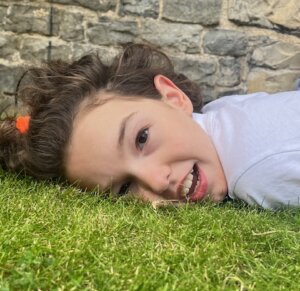 Jenny, 48, from Manchester, says: “There was nothing unusual about the pregnancy and birth and in the first year Florence seemed quite advanced for her age. But she didn’t progress from 18 months and then she regressed.”
Florence was diagnosed at the age of two with a very rare genetic condition called late infantile GM1 gangliosidosis. It is a genetic condition that progressively destroys nerve cells in the brain and spinal cord and is so rare it only affects 1 in 100,000 to 200,000 newborns. It is a severe and regressive condition, heartbreaking for parents as children gradually lose developmental skills. This means they lose the ability to walk, to talk, to sit unaided, support their heads and eat and swallow.
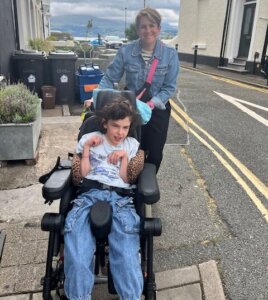
“The diagnosis was horrendous,” Jenny recalls. “Florence went for blood tests and brain scans, which were horrible as she had to be sedated. Our whole world was turned upside down. We were told to go home and make memories with her as she wouldn’t live past the age of ten. It has been regressive since she was diagnosed, so she can’t walk and she can’t sit up unaided. She used to crawl on her hands and knees, but she can’t now. She has a feeding tube in her stomach. She is non-verbal, but she can make herself understood. Florence takes medication for seizures and she is incontinent. She needs to be looked after 24/7.”
 Jenny had genetic testing which showed she is a carrier of the faulty gene which causes GM1. It is usually carried by both parents, but Florence’s Dad hasn’t been tested, and the couple are now divorced. Florence’s 14-year-old brother Riccardo could be tested to see if he’s a carrier when he is 18.
In the early days, Jenny had a lot of contact with the GM1 Foundation in America, travelling to the US three times, fundraising and hoping for a cure for Florence. She narrowly missed out on a place on a preliminary clinical trial.
Jenny says: “There were only places for five children and Florence was the sixth. It was around the time that Covid hit, so looking back it was a blessing she didn’t get on the trial. I’ve made peace with that now and hope that one day in the future a cure will be available for all the children with GM1.
“As a parent, it hangs over you every single day, it’s an anticipatory grief. I am very accepting of the situation, and I’ve had a lot of counselling. We have moved to an accessible home to make everyday life easier. I think every day we have her with us is special. We are all about making memories. Looking back, we were told she wouldn’t live past the age of ten and now she has just turned 12!”
Jenny adds: “We have been well supported by a team – physio, OT, cranial osteopathy, and doctors. Some of that she has in school and some I have to pay for. Her special needs school is fantastic; she even has a hydrotherapy pool. Now she is not mobile at all, so she either uses a wheelchair or is on the floor. Fortunately, I can lift her as she is light, weighing 20kg, like a little doll. I have some respite care at home as Florence needs round the clock care. Riccardo is very good, helping out and he can cook tea.”
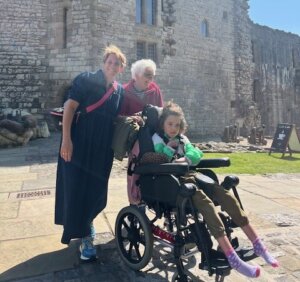 The family enjoyed a stay at The Sandcastle Trust’s caravan in Wales last summer, which is part of the Trust’s Family Respite Service provided for families just like Florence’s. Respite breaks give families the opportunity to spend quality time together in a fully accessible holiday caravan, giving them a break from the daily routine of caring and enabling families to refresh and reconnect.
Jenny says: “It was so pretty and lovely and everything was on site – two restaurants, a pub, a lake, a swimming pool, even a launderette. Riccardo swam every day and it was a lovely base for us to have a holiday. Mum came with me to help out. The fully adapted caravan was brilliant for Florence. Breaks away can be hard work, but it just made it all so manageable.
“Florence likes being out and about. She likes seeing different places. She likes going for walks. She is happy being surrounded by her family and people watching.”
Coping with a child with complex needs, who needs 24/7 care is of course challenging, as Jenny describes.
“It’s a rollercoaster ride,” Jenny explains. “It is mentally and physically hard, there’s mental anxiety, and we have been told what the future holds for Florence, but there are also good times. You have to accept it. The more I’m angry about it, the more it takes some of you away. You have an inner strength that you can find. I don’t have a choice but to cope, especially as a single parent.
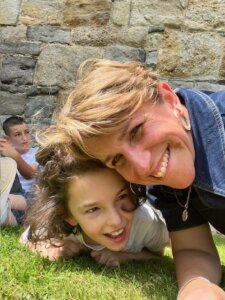 “In the meantime, life goes on for everybody else. Ricardo still deserves to have a life; I deserve to have a life and a career. I’m currently training to be a counsellor, and I’d like to work in child bereavement services.”
Jenny adds: “It’s hard to see photos when Florence was younger. It’s heart breaking. I won’t see her get married or have children, but you come to terms with that. They are still a little person. Florence is a gorgeous girl; she brings me joy and there is joy to be found in the everyday things. We give her the best opportunities that she can have.”
Louie’s Story
It was at five-months-old that Mum Natalie McDougall started to worry about her first-born son Louie.
“He was born very small, just 4lb 11oz, but at five-months-old his foot had dropped into a pointed position,” Natalie, recalls. “He wasn’t meeting milestones, wasn’t sitting up or bearing any weight on his legs.”
Louie was referred to a paediatrician and diagnosed with hypotonia, which is low muscle tone. He had a cast fitted to correct the foot drop and started further tests to determine what could be causing it.
Doctors initially suspected spinal muscular atrophy, but the test came back negative when Louie was seven-months-old. Then in December 2012, Louie, by now aged eight-months-old, became very unwell.
Natalie, from Mitcham, Surrey, says: “We were out shopping when Louie collapsed and stopped breathing. He was rushed to hospital where doctors told us he had respiratory bronchiolitis and his diaphragm had become paralysed. It was the last time he was able to breathe for himself and he was ventilated in hospital for the next seven months.”
Louie was transferred to the Evelina London Children’s Hospital and tested for the rare genetic disorder SMARD (spinal muscular atrophy with respiratory distress). The test came back positive in January 2013. SMARD is an inherited neuromuscular degenerative disease that causes infants to lose voluntary muscular functions, such as breathing and swallowing.
One in 50,000 people carry mutations in the IGHMBP2 gene that is linked to SMARD. Natalie and Louie’s father, Reece were both found to be carriers of the faulty gene.
In SMARD, the link between the brain, the spinal cord and muscles is impaired. Muscles can no longer be stimulated, which causes them to waste and it affects every single muscle in the body. SMARD is a life-limiting condition and there is no treatment available.
Natalie explains: “We were devastated. The doctors told us we needed to let Louie go naturally and there was no hope. I didn’t know 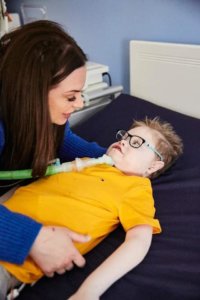 anything about genes or SMARD, but I researched it and pushed for a tracheostomy to be fitted which would enable my baby to come home. In March 2013 Louie had the tracheostomy fitted and was home four months later with a ventilator, which is the size of a lunchbox.”
At first Louie could still move his limbs, but the condition progressed quickly and he became fully paralysed from the neck down, unable to walk, sit up, lift his head and or speak.
With such complex needs, Louie needed round the clock medical care – which Natalie and Reece were trained to do with some help from night-time nurses.
“We ran our home like an Intensive Care Unit. It was hard work, particularly since we had other children,” Natalie explains. “We both had to give up our jobs to care for Louie. We didn’t want to leave Louie in a hospice.”
Natalie adds: “Despite being under the care of the palliative care doctors Louie was a happy and smiley boy. He loved to be cuddled by his brothers and watch Disney films. He was home schooled by a tutor for one hour a day and used an eye-gaze for simple words.”
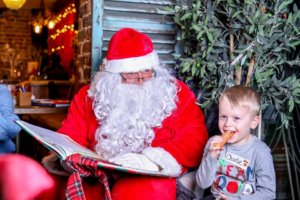 Natalie says: “I was really worried about having other children. We saw a geneticist and whilst the love you have is the same for each child, we decided we wouldn’t continue with a pregnancy if we had another baby with SMARD. I had a CVS diagnostic test with all three pregnancies.
“We attended The Sandcastle Trust Christmas party in 2018,” Natalie explains. “Unfortunately, Louie wasn’t well enough to go, but his younger brothers had a lovely time and it was really helpful to meet other families with rare genetic disorders, share experiences and have support from the charity.”
Then, tragically, on 10 May 2019, aged 7, Louie passed away leaving his family completely devastated.
“Although Louie had a life limiting condition you can never really be prepared to lose a child.” Natalie explains: “When Louie was with us, life was a lot more restricted and our lives revolved around him. Losing him was completely life changing and our whole family found it hard to adjust to our ‘new’ life.”
Louie’s three younger brothers struggled to understand his loss, particularly Charlie. Natalie explains: “Charlie finds Louie dying hard to talk about and will often burst into tears or just say he doesn’t want to talk about it.”
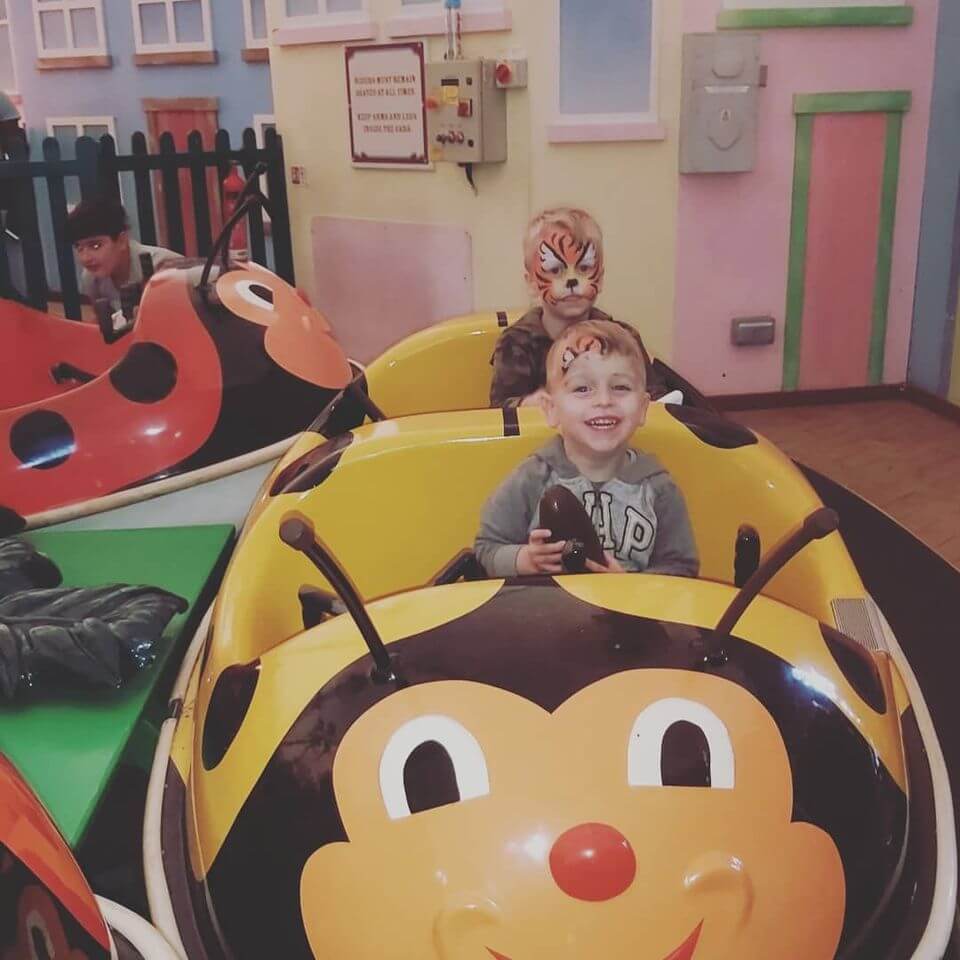
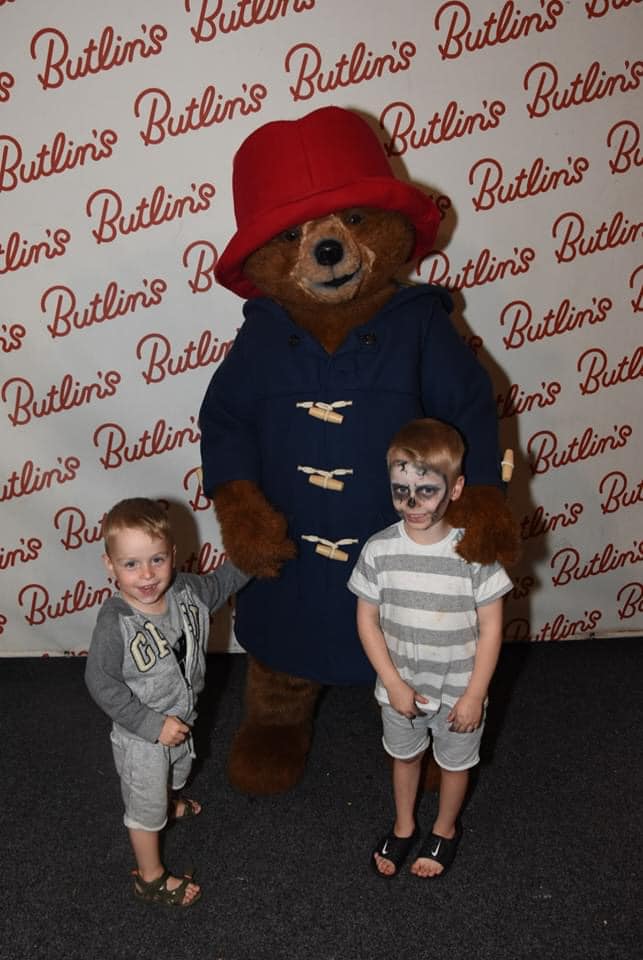
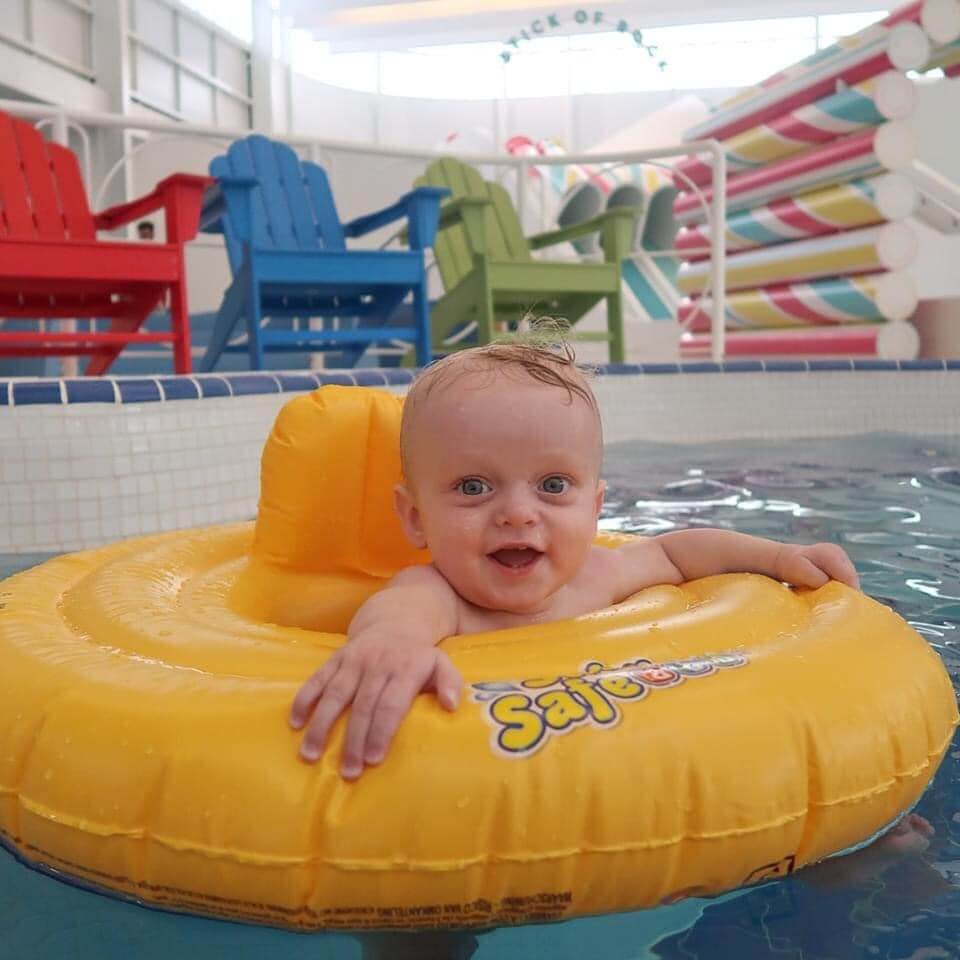
The family was supported by The Sandcastle Trust after Louie’s death. Natalie says: “The Sandcastle Trust arranged for us to have a short break at Butlins. It allowed us a chance to remember Louie and relax whilst creating some fun, happy family memories for Charlie, George and Arthur. Charlie said it was “the best holiday ever!”
Natalie adds: “Louie taught me so much during his life and how to truly love and care for someone. I will miss him every day for the rest of my life.”
Elijah’s story
Two-year-old Elijah Middleton was born with a rare genetic condition called PTEN hamartoma tumour syndrome (PTEN / PHTS for short). There is no cure or treatment available for this condition, which has wide ranging symptoms and carries an increased risk of certain cancers.
Parents Becky, 30 and Tim, 31, from Carmarthenshire, first noticed Elijah wasn’t meeting his developmental milestones during his eight week check-up. Elijah was born weighing 10lb 1oz and with a very big head and at eight weeks old his muscle tone was too low to support his head. He also had delayed motor development. He was referred to a paediatric consultant where he had a number of tests and assessments and then onto a geneticist who straight away suspected PTEN syndrome. PTEN syndrome is caused by changes in the PTEN gene, which is a tumour suppressor. An alteration in this gene can lead to non-cancerous tumours and increase the lifetime risk of some types of cancerous tumours too. Elijah’s genetic testing came back positive, and the family got a diagnosis in October 2022, when he was 15 months. By then his gross motor skills and speech and language were very delayed.
Becky explains: “After the geneticist explained what PTEN was and the symptoms associated with it, it sounded so much like Elijah. We were almost expecting to hear that the test was positive for PTEN, but it was still a massive shock. We all had blood tests, including our eldest son Asher, who is four, but none of us have the condition. We really don’t know what the future holds as it can cause fatty lumps which can be cancerous. So far Elijah has just had a scan on his abdomen for lumps. He has vomiting episodes which means he loses weight. He always seems to be poorly as his immune system is not great.
“There is a lot of guesswork in looking after Elijah as he doesn’t communicate his needs. He has very few words so can’t tell us if he is hungry or thirsty. He struggles to understand that a ball means we play, or a bath is bath time. He doesn’t always respond to speech, but it is too early for an autism diagnosis.”
Speech and Language have been supporting him and providing strategies to better support Elijah and his family. The family are waiting for a referral to a dermatologist to check Elijah’s skin for lumps that may become cancerous. When he is around seven, Elijah will be monitored for any lumps on the thyroid gland. He has physio for his low muscle tone, balance, co-ordination and hypomobility. During the summer he will have six weeks of hydrotherapy. He is also having hearing tests and waiting to have an overnight pulse oximetry sleep study.
Becky says: “The diagnosis period has been very stressful on family life. Tim now works at home, he’s a Learning and Development Advisor, so he can help when he can, but it’s not easy. I’m with Elijah 24/7. I have to get in the bath with him as his muscle tone is too low to sit safely. He slumps when he is eating and bathing. We are waiting for a specialist highchair and bath chair which will make a big difference. My family are an hour away and Tim’s family are in Shropshire, so we have no family close by. Going out and doing normal family activities are so difficult for us. We hadn’t been on a holiday together with the children due to Covid and then it just seemed too scary and daunting.”
The couple applied for the Sandcastle Trust’s programme Sandcastle Memories, which offers respite for families living with a rare genetic condition, in the form of UK breaks and days out.
The Sandcastle Trust wanted to help Becky and Tim create special memories with Elijah and Asher and were able to arrange a week’s stay in May at Calcite Cabin, Trevassack Lake in Cornwall.
“I broke down in tears when I heard we had been granted the holiday,” Becky says. “After all the assessment and diagnosis, we had gone through a rollercoaster of emotions, for the Sandcastle Trust to say you can get away, have a break from the hospital appointments and take a step back and just be a family, was such a blessing for us all.”
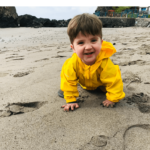
“The house was perfect. It was gated off and Elijah could crawl around safely. We went to soft play, an aquarium and visited a farm. The beach was so close we were back and forth to it every day. It was nice to see Elijah’s face light up. We also walked around the Lizard and took a trip to Newquay. The area is beautiful and so peaceful. Then once bedtime hit Tim and I chilled out in the hot tub.”
Becky adds: “The boys loved the holiday and for us it helped us to relax and was great to give our minds some respite. We had been feeling a lot of anxiety about what the future would be like but the week in Cornwall gave us a breather from our everyday life, it changes your outlook and your ability to cope with the condition. It gave us confidence, look what we could do in a week! We can’t thank the Sandcastle Trust enough.
“Amazingly Elijah tried to stand up in the sand which was really exciting for us as he wasn’t standing independently before. He seemed so much more engaged and enjoyed spending time as a whole family. It was such a great week!”